Top Pharma Companies by Revenue in 2025, Drug by Drug
BWBiopharmaWatch Research··10 min read
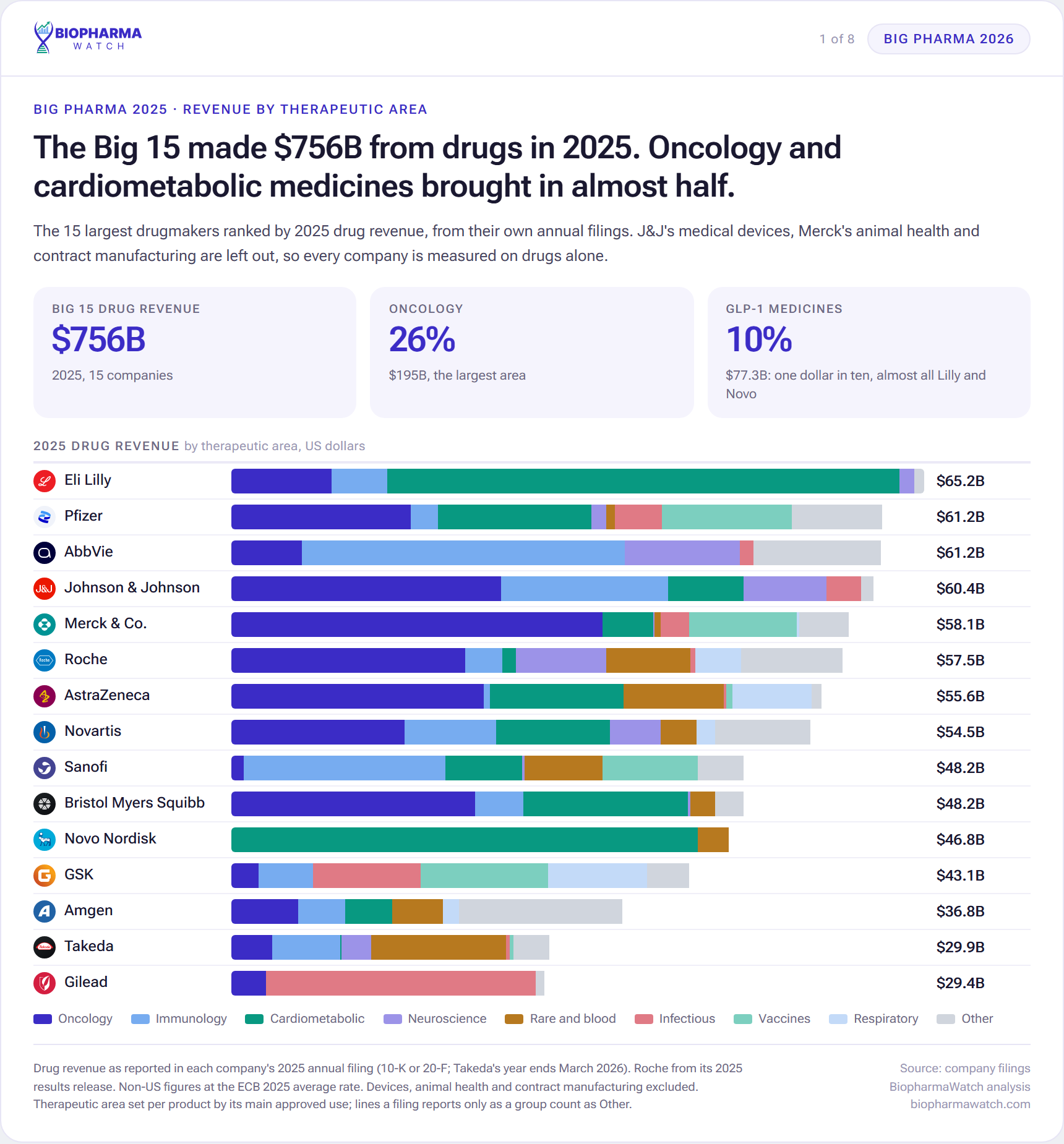
The top pharma companies by revenue made $756 billion from drugs in 2025, and one class of medicine explains more of that than any other. GLP-1 drugs brought in $77.3 billion, one dollar in every ten, and two companies booked almost all of it. LLY Eli Lilly is now the largest drugmaker on drug revenue alone, at $65.2 billion.
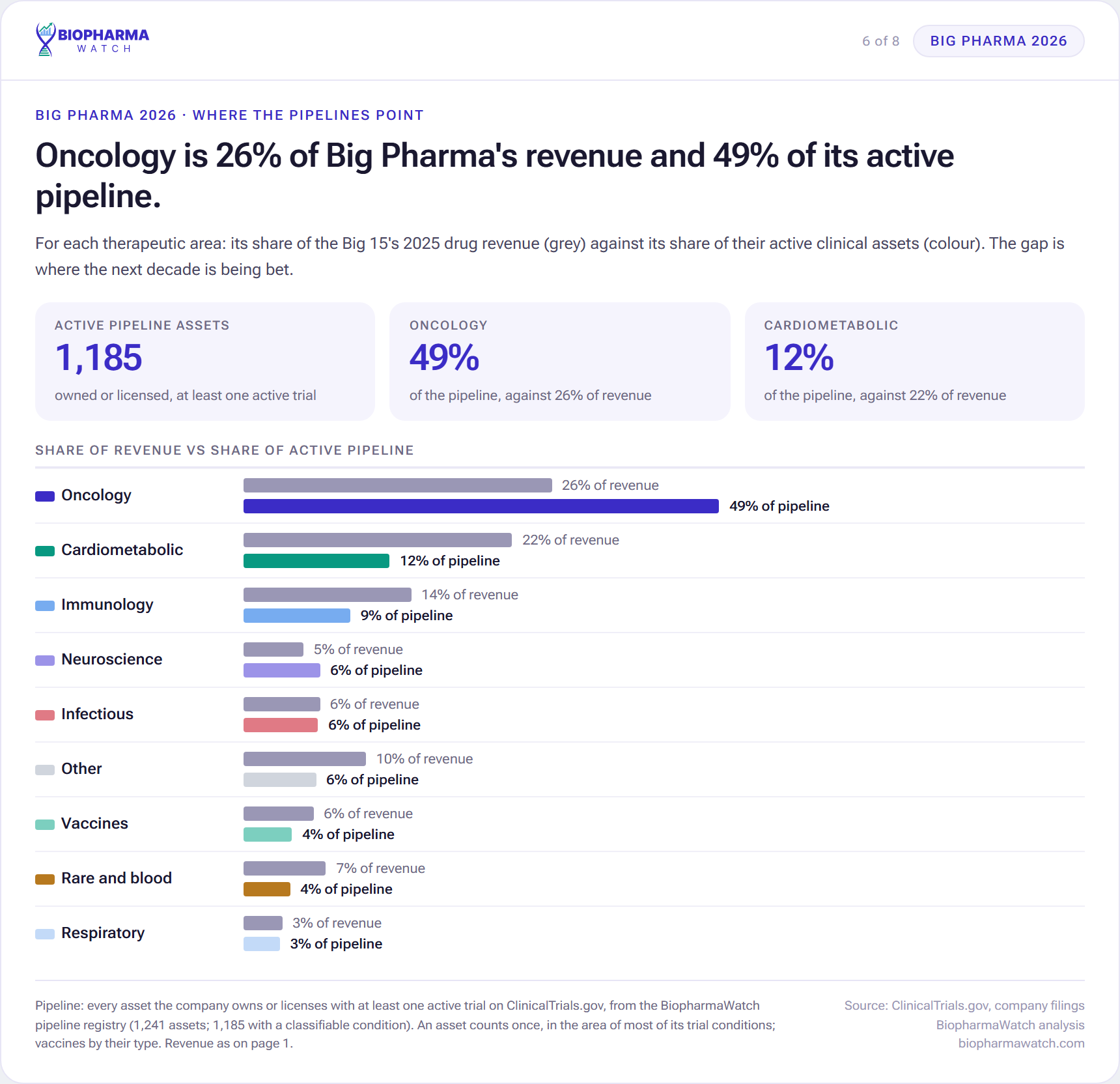
We built this from the annual filings of the 15 largest drugmakers, product line by product line, and gave every product a therapeutic area. Then we did the same for what they are developing next: 1,185 assets the companies own or license, each with at least one active clinical trial. The two pictures do not match. Oncology is 26% of what Big Pharma sells today and 49% of what it is testing.
Which pharma companies made the most money in 2025?
Eli Lilly, by a clear margin, once you count drugs and nothing else. Pfizer and AbbVie follow at $61.2 billion each, then Johnson & Johnson at $60.4 billion and Merck at $58.1 billion. The order changes if you count everything a company sells: J&J's total revenue is $94.2 billion, but $33.8 billion of that is medical devices. Merck books another $6.4 billion from animal health. We left both out, so every company here is measured on the same thing, its medicines.
Two lines need a word of explanation. Sanofi and Bristol Myers Squibb finished within $2 million of each other, so their order is a rounding matter. And Amgen's largest single bucket is not an area at all: 42% of its drug revenue sits in lines its filing reports only as "other products", plus bone drugs such as Prolia and Evenity that fall outside our nine areas, so we show its largest named area instead.
How much of Big Pharma's revenue comes from GLP-1 drugs?
$77.3 billion in 2025, or 10.2% of everything the top 15 earned from drugs. Lilly booked $40.8 billion of it across Mounjaro, Zepbound and Trulicity. Novo Nordisk booked $36.2 billion across Ozempic, Wegovy, Rybelsus and its older liraglutide brands. Sanofi's Soliqua, an insulin and lixisenatide combination, adds $0.3 billion. Nobody else on the list sells one at scale.
That concentration is the striking part. Cardiometabolic medicine as a whole is the second largest area, at $170 billion, but almost half of it now comes from one mechanism sold by two companies. For Novo it is the business: 94% of its drug revenue is cardiometabolic. For Lilly it is 74%, which is why the rest of its pipeline gets so much attention.
Which pharma companies depend most on a single drug?
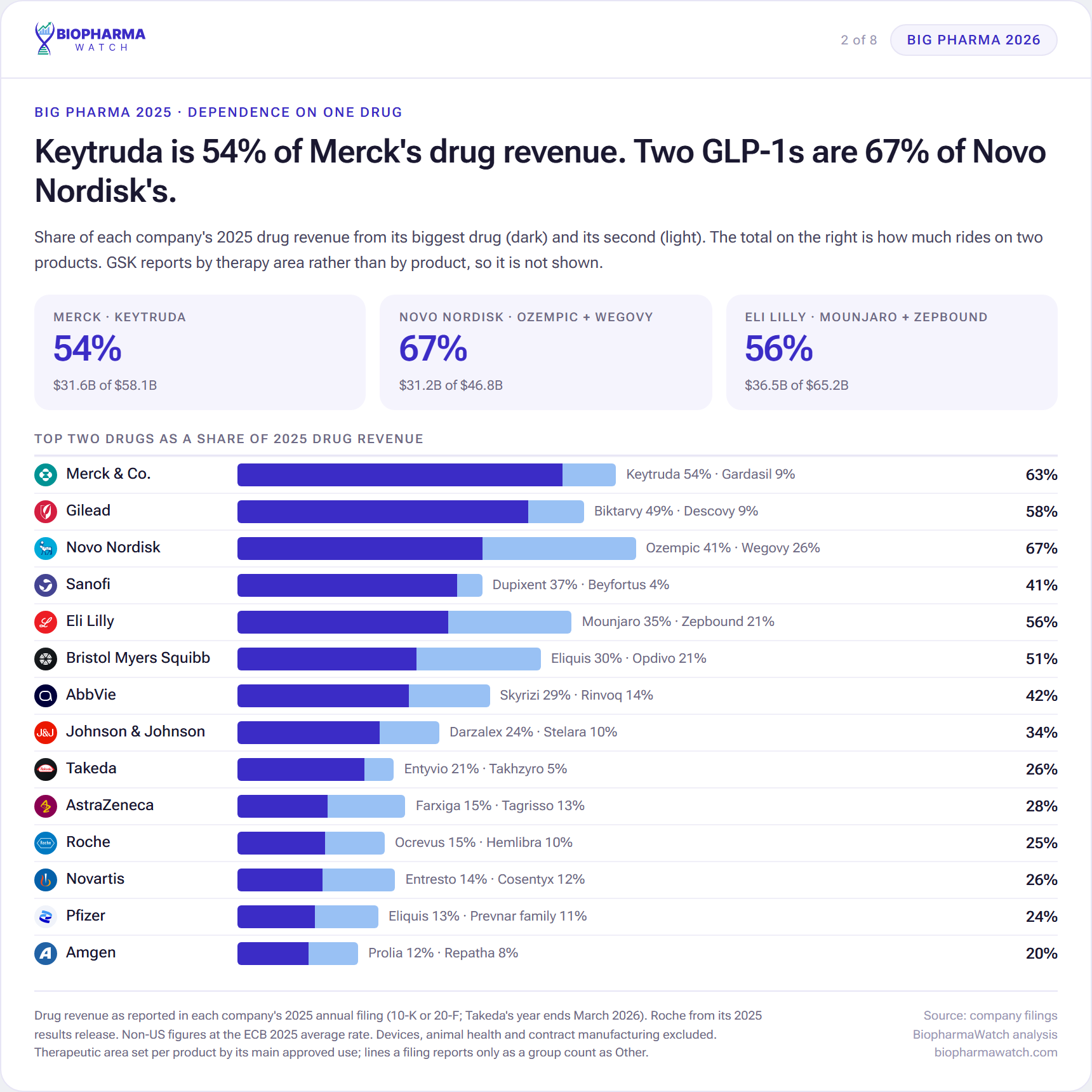
Merck. Keytruda brought in $31.6 billion in 2025, 54% of Merck's drug revenue, and adding Gardasil takes two products to 63%. Gilead is close behind: Biktarvy alone is 49%. At Novo Nordisk, Ozempic is 41% and Ozempic plus Wegovy are 67%. At Lilly, Mounjaro and Zepbound together are 56%.
Dependence cuts both ways. A product that carries half the revenue funds the whole pipeline while it grows, and decides the company's next decade when it loses exclusivity. Our read is that the companies at the top of this chart are the ones whose BD deals and late-stage readouts deserve the closest attention, because each one is being asked to replace something very large. At the other end, Amgen (12% from Prolia) and Pfizer (13% from Eliquis) are the least exposed to any single product, though Pfizer's figure counts only its own share of Eliquis.
What were the best-selling drugs of 2025?
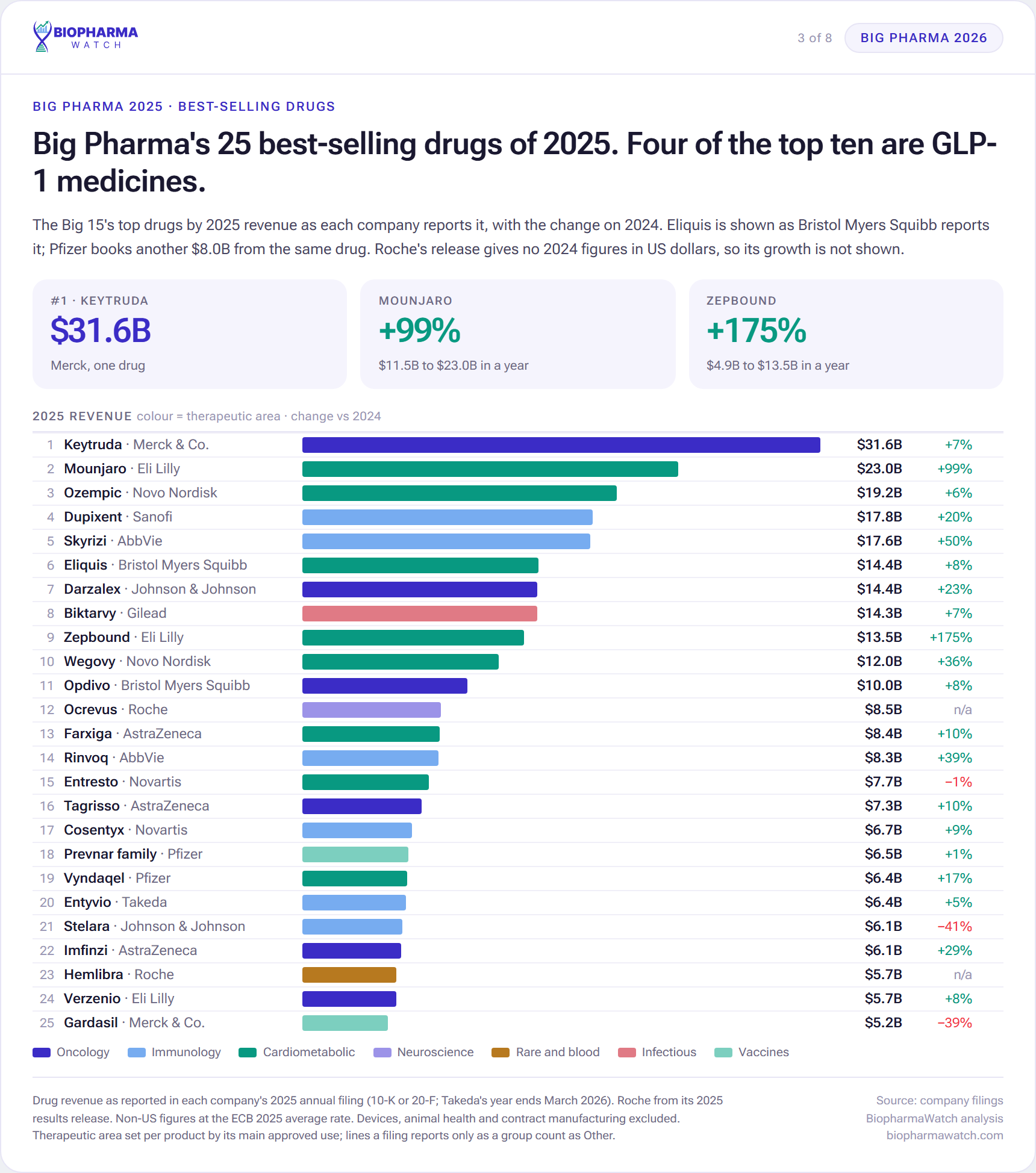
Keytruda, at $31.6 billion and up 7%, is still the best-selling drug in the world by a wide margin. Mounjaro is second at $23.0 billion, almost double its 2024 figure. Four of the top ten are GLP-1 medicines: Mounjaro, Ozempic, Zepbound and Wegovy. The ten largest together brought in $177.8 billion, close to a quarter of the Big 15's entire drug revenue.
The rest of the top ten tells you where the money sits outside obesity and diabetes. SNY Sanofi's Dupixent ($17.8 billion, up 20%) and ABBV AbbVie's Skyrizi ($17.6 billion, up 50%) are immunology. JNJ J&J's Darzalex ($14.4 billion) is myeloma. GILD Gilead's Biktarvy ($14.3 billion) is HIV. Eliquis appears as Bristol Myers Squibb reports it, $14.4 billion; Pfizer books a further $8.0 billion from the same drug, so the combined figure is larger than either line suggests.
Two products in the top 25 shrank hard. Stelara fell 41% to $6.1 billion as biosimilars reached the market, and Gardasil fell 39% to $5.2 billion.
Where does each Big Pharma company make its money?
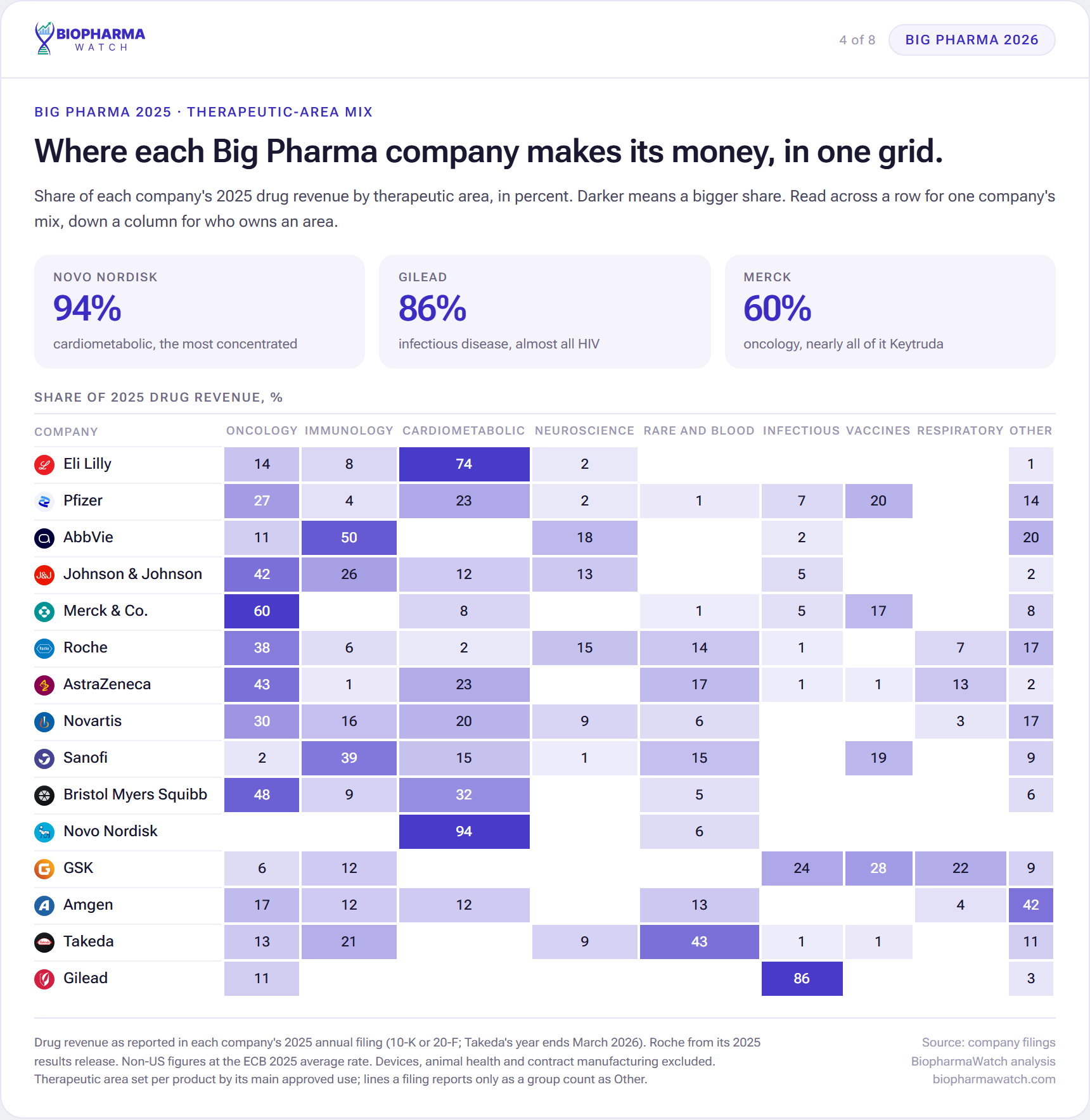
The heat map below is the quickest way to see each company's shape. Read across a row for one company's mix, or down a column to see who owns an area.
Three companies are close to single-area businesses. NVO Novo Nordisk is 94% cardiometabolic, Gilead is 86% infectious disease, and MRK Merck is 60% oncology, nearly all of it Keytruda. At the other extreme, PFE Pfizer is the most spread out: its largest area, oncology, is only 27%, with cardiometabolic at 23% and vaccines at 20%. GSK GSK is the vaccine company of the group at 28%, and TAK Takeda is the rare disease and plasma company, at 43%.
Across all fifteen, oncology is the largest area at $195 billion (26%), then cardiometabolic at $170 billion (22%) and immunology at $106 billion (14%). Neuroscience, a field with enormous unmet need, is only $38 billion, 5% of the total.
Which drugs gained and lost the most revenue in 2025?
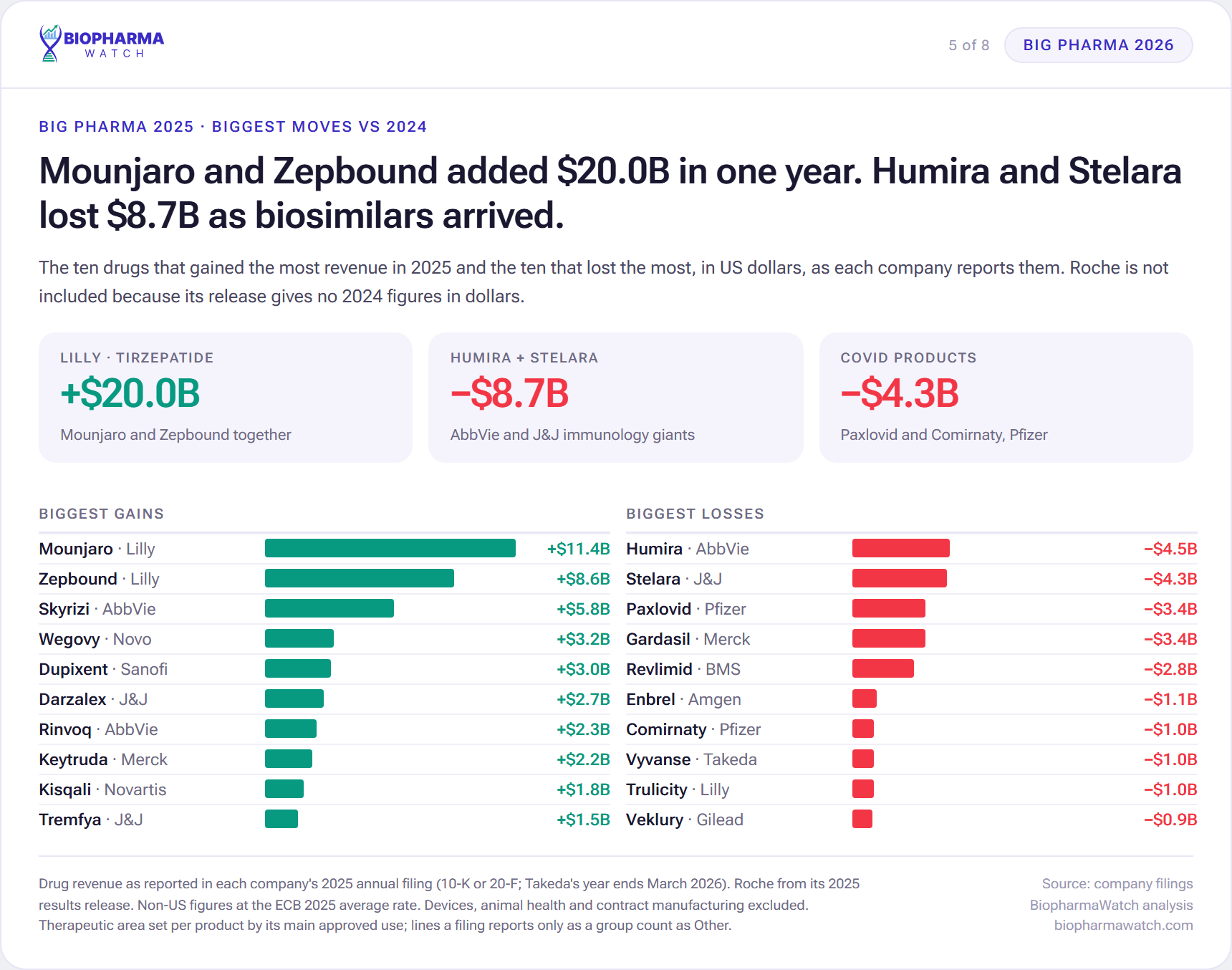
Mounjaro added $11.4 billion in a single year and Zepbound added $8.6 billion, so tirzepatide alone grew by $20.0 billion. That is larger than the entire annual drug revenue of most companies outside this list. Skyrizi added $5.8 billion, Wegovy $3.2 billion and Dupixent $3.0 billion.
The losses are the other half of the story. Humira lost $4.5 billion and Stelara $4.3 billion, $8.7 billion between them, as biosimilars arrived. Pfizer's COVID products shrank again: Paxlovid by $3.4 billion and Comirnaty by $1.0 billion. Gardasil lost $3.4 billion and Revlimid $2.8 billion. AbbVie is the interesting case on both lists. Skyrizi and Rinvoq together added $8.2 billion, comfortably more than Humira lost, which is about as clean a handover from one immunology franchise to the next as this industry has managed.
Which therapeutic areas grew fastest in 2025?
Cardiometabolic, and it was not close. Across the 14 companies that report a 2024 comparison (Roche's release does not give one in dollars), drug revenue grew 7.2%, from $650.3 billion to $697.0 billion. Cardiometabolic medicine grew 19.7%, adding $27.8 billion, and GLP-1 drugs alone grew 40.3%, from $55.1 billion to $77.3 billion. Those $22.2 billion are 48% of all the growth on the list, from one class of drug.
Take GLP-1s out and cardiometabolic grew 6.4%, in line with everything else. Oncology added $13.3 billion (8.4%) and immunology $6.9 billion (7.2%), with neuroscience up 7.6% from a much smaller base. Two areas shrank: vaccines fell 8.0%, losing $3.8 billion as COVID and HPV vaccine sales dropped, and infectious disease fell 5.4% as Paxlovid faded. Figures are in US dollars, so currency moves at the non-US companies are part of the change.
Where is Big Pharma's pipeline pointing?
Into oncology, far more than the revenue alone would suggest. Of the 1,185 assets the fifteen own or license with at least one active trial, 49% are cancer programmes. Oncology is 26% of today's revenue. Cardiometabolic goes the other way: 22% of revenue but only 12% of the active pipeline, because the GLP-1 money sits with two companies while the other thirteen mostly bet elsewhere.
A caution on reading this. We count each asset once, whatever its phase, so a dozen early oncology programmes weigh as much as a dozen late ones. Cancer trials are also smaller and more numerous by nature, which inflates the count. Even so, the gap is too large to explain away. When half of what the largest companies are testing is cancer, the competition for patients, investigators and eventually prescriptions in oncology will be intense.
Which Big Pharma companies are changing direction?
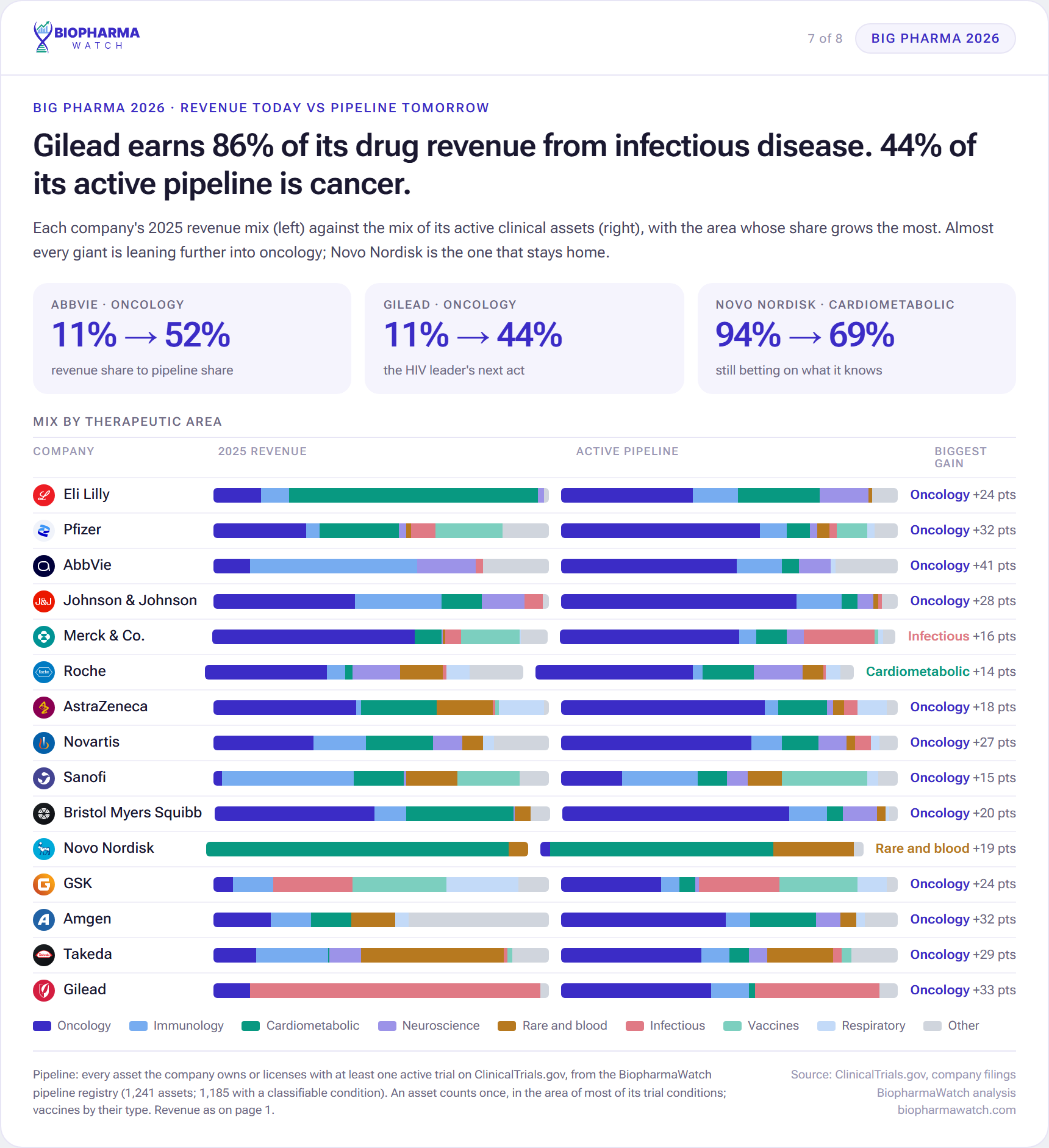
Almost all of them, and mostly toward cancer. Comparing each company's revenue mix today with the mix of its active pipeline shows where the next decade is being bet.
AbbVie makes 11% of its drug revenue from oncology, and 52% of its active pipeline is cancer. Gilead makes 86% of its money from infectious disease, almost all HIV, yet 44% of its pipeline is oncology. AMGN Amgen goes from 17% to 49%, and Pfizer from 27% to 59%. RHHBY Roche is the notable exception in direction: its biggest move is into cardiometabolic, from 2% of revenue to 16% of the pipeline. Merck's biggest move is into infectious disease, where its pipeline share is 16 points above its revenue share.
Novo Nordisk is the one staying home. Cardiometabolic is 94% of its revenue and still 69% of its pipeline. Whether that focus is discipline or concentration risk is the central question for the stock, and the data alone does not answer it.
Which drug targets are the most crowded among the Big 15?
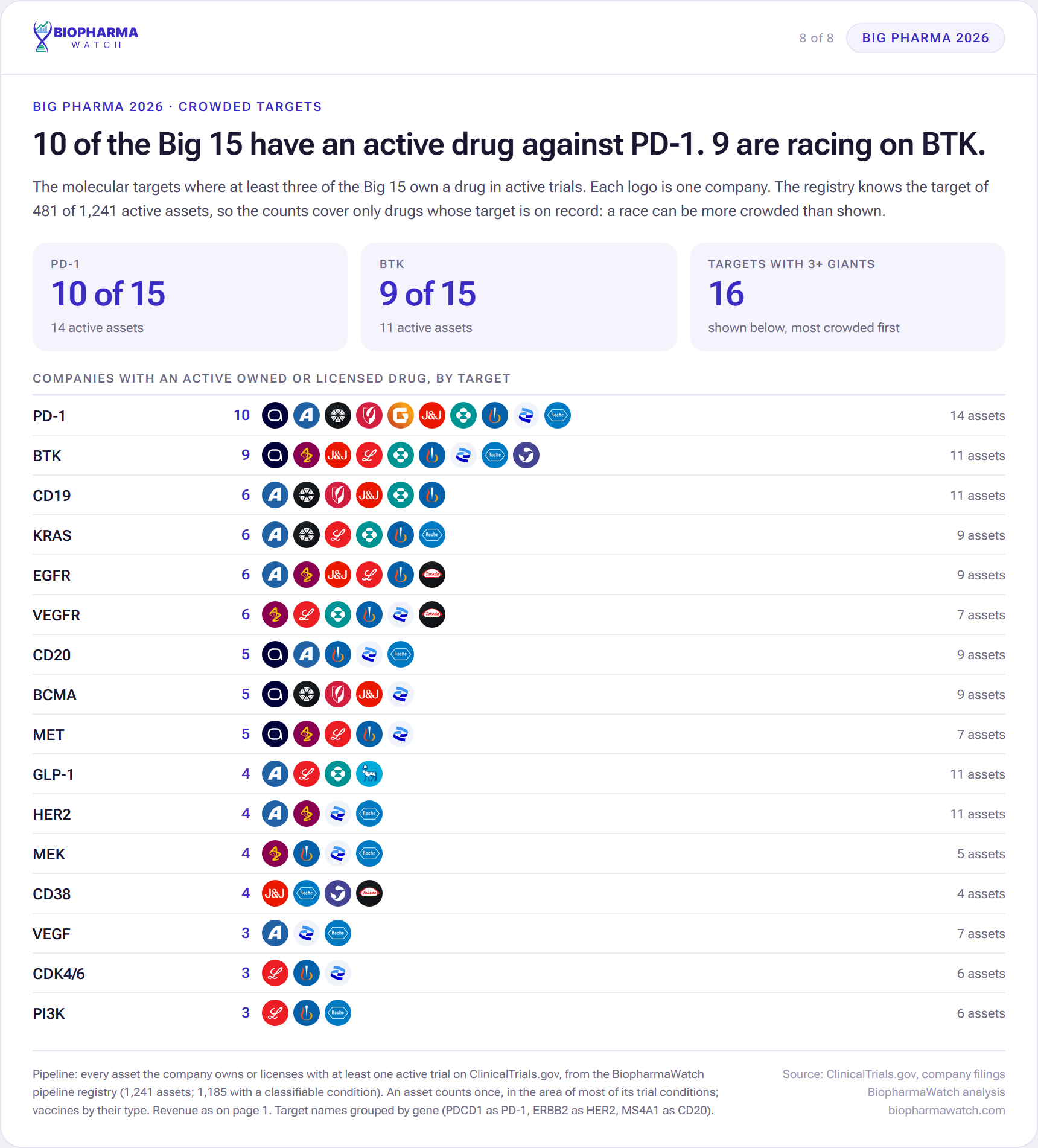
PD-1. At least 10 of the 15 companies own a drug against it in active trials. Nine are racing on BTK, and six each on CD19, KRAS, EGFR and VEGFR.
These counts are minimums. Our registry records the molecular target for 481 of the 1,241 active assets these companies own, so a race can be more crowded than shown here. GLP-1 is the clearest example: four companies appear with an active GLP-1 drug, but several more have publicly disclosed programmes whose target the registry has not yet resolved. For a fuller view of crowding among smaller companies, see our Target Crowding report, where 19 small and mid cap biotechs are chasing CD19.
How did we build these numbers?
Revenue comes from each company's own annual filing: the 10-K for US companies and the 20-F for foreign ones, for fiscal 2025. Takeda's fiscal year ends in March 2026. Roche files nothing with the SEC, so its figures come from its 2025 full-year results release, which gives its 20 largest products and the division total. Non-US figures are converted at the ECB average rate for 2025.
Drug revenue only: medical devices, animal health, contract manufacturing and distribution are excluded.
Each product line gets the therapeutic area of its main approved use. Lines a filing reports only as a group stay unallocated rather than guessed.
GSK reports by therapy area rather than by product, so it appears in the area charts but not in the single-drug ones.
Pipeline: every asset a company owns or licenses with at least one active trial on ClinicalTrials.gov, from the BiopharmaWatch pipeline registry, counted once in the area of most of its trial conditions.
Shared drugs are the main trap. Where two partners each book revenue from one product, as with Eliquis, Imbruvica and Lynparza, each company's figure is its own, and we do not add them together in the rankings.
Every company in this post has its own page on BiopharmaWatch with its full pipeline, catalysts and recent news, and the biotech screener covers more than 900 drugmakers. Subscribers also see modeled odds of approval for each drug, cash runway and insider activity; you can start a free trial to see them. For the decisions coming up next, the FDA calendar and our Q4 2026 PDUFA dates post list every one, and the Disease Map shows where smaller companies are competing by indication.
Frequently asked questions
Which pharma company had the highest revenue in 2025?›
Eli Lilly, with $65.2B of drug revenue. Pfizer and AbbVie follow at $61.2B each. Johnson & Johnson's total revenue is higher, $94.2B, but $33.8B of that is medical devices; its drug business made $60.4B.
What was the best-selling drug in 2025?›
Keytruda, at $31.6B, up 7% on 2024. Mounjaro was second at $23.0B, almost double its 2024 figure, and Ozempic third at $19.2B.
How much revenue do GLP-1 drugs make?›
$77.3B across the top 15 pharma companies in 2025, 10.2% of their drug revenue. Eli Lilly booked $40.8B and Novo Nordisk $36.2B; Sanofi's Soliqua adds $0.3B.
Which therapeutic area makes the most money for Big Pharma?›
Oncology, at $195B or 26% of the top 15's drug revenue in 2025. Cardiometabolic medicine is second at $170B (22%) and immunology third at $106B (14%).
Which pharma company depends most on a single drug?›
Merck: Keytruda is 54% of its drug revenue. Gilead's Biktarvy is 49%, and at Novo Nordisk, Ozempic alone is 41%.
Where are Big Pharma pipelines focused?›
On oncology. Of the 1,185 assets the top 15 own or license with an active trial, 49% are cancer programmes, against 26% of today's revenue. Cardiometabolic is 22% of revenue but 12% of the pipeline.
Where does this data come from?›
Each company's fiscal 2025 annual filing (10-K or 20-F; Takeda's year ends in March 2026), Roche's 2025 results release, the ECB average 2025 exchange rate, and the BiopharmaWatch pipeline registry built from ClinicalTrials.gov.