The Most Crowded Drug Targets in Biotech: 19 Companies Are Chasing CD19
BWBiopharmaWatch Research··13 min read
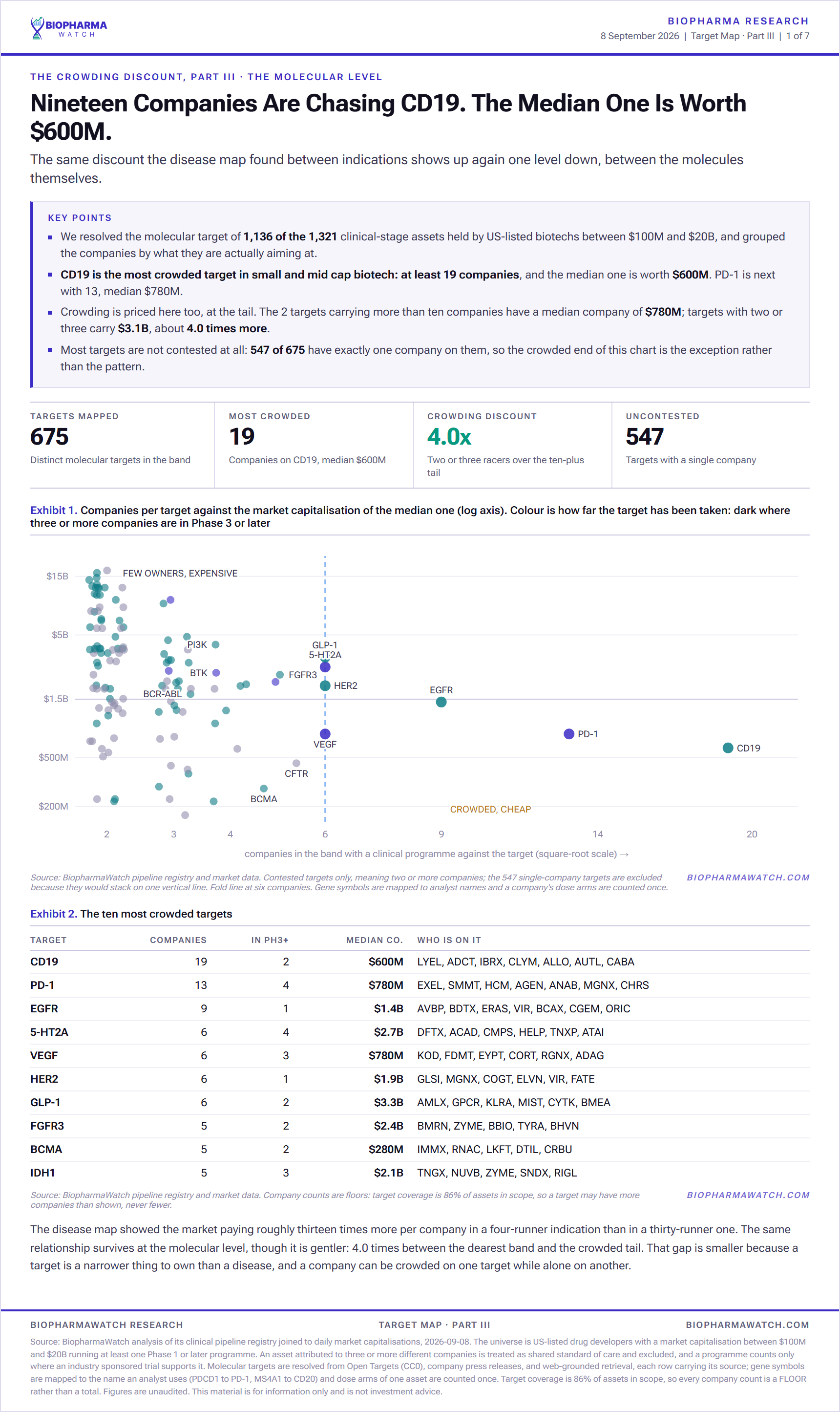
19 US-listed biotech companies are running a clinical programme against CD19, the most contested molecular target in the small and mid cap market. The median one is worth $600M. At the other end of the same dataset, 547 of 675 molecular targets have exactly one company on them. Biotech is not a crowded sector. A handful of molecules are crowded, and the rest of the map is close to empty.
That comes from mapping every proprietary clinical-stage drug programme held by a US-listed developer capitalised between $100 million and $20 billion, then grouping those companies by the molecule they are aiming at rather than the disease they are chasing with it. This is Part III of the Crowding Discount. Part I mapped 299 diseases and found the market paying far more per company in a thin indication than a crowded one. Here we ask the same question one level down, between the molecules themselves.
How many companies are developing drugs against the same molecular target?
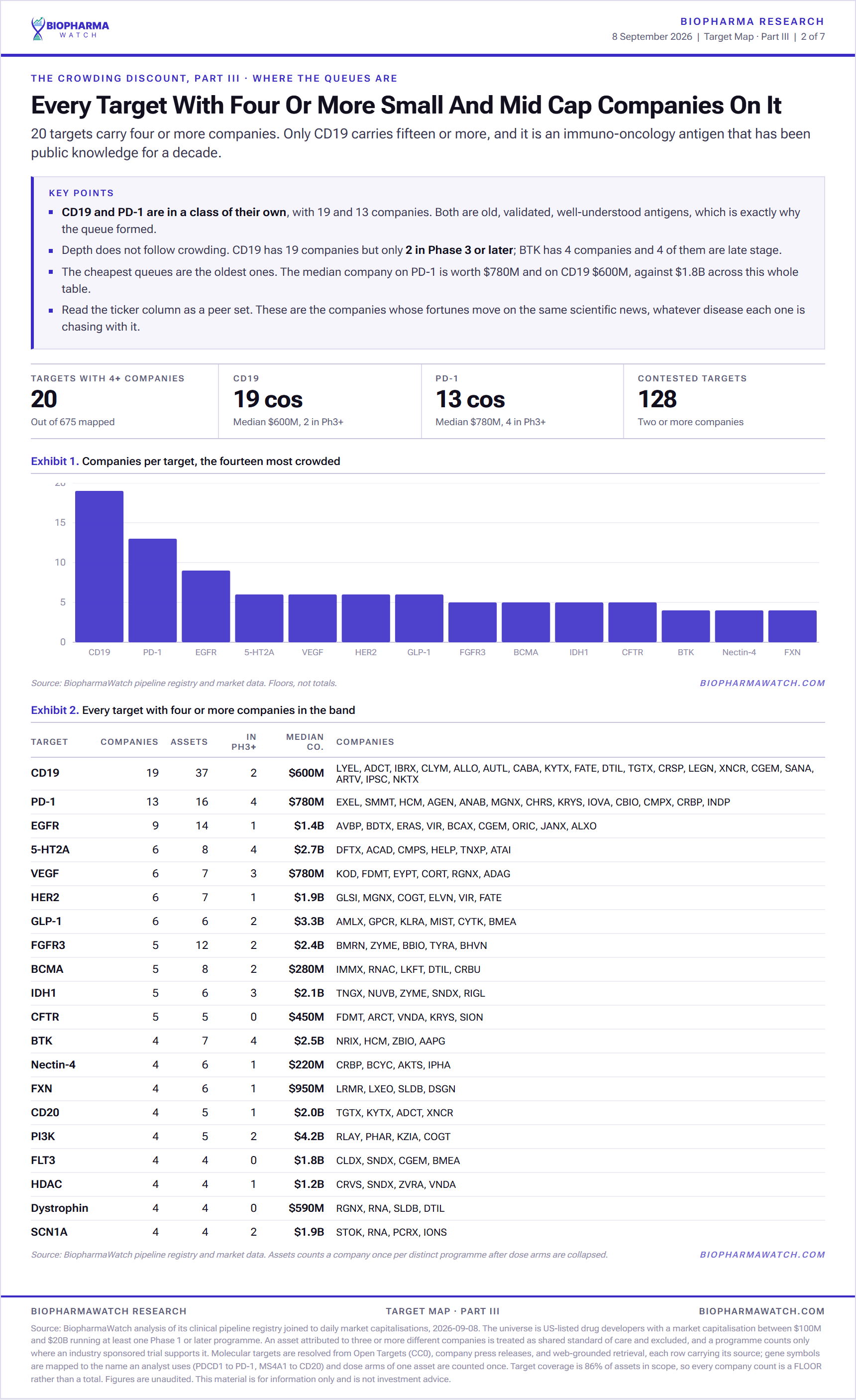
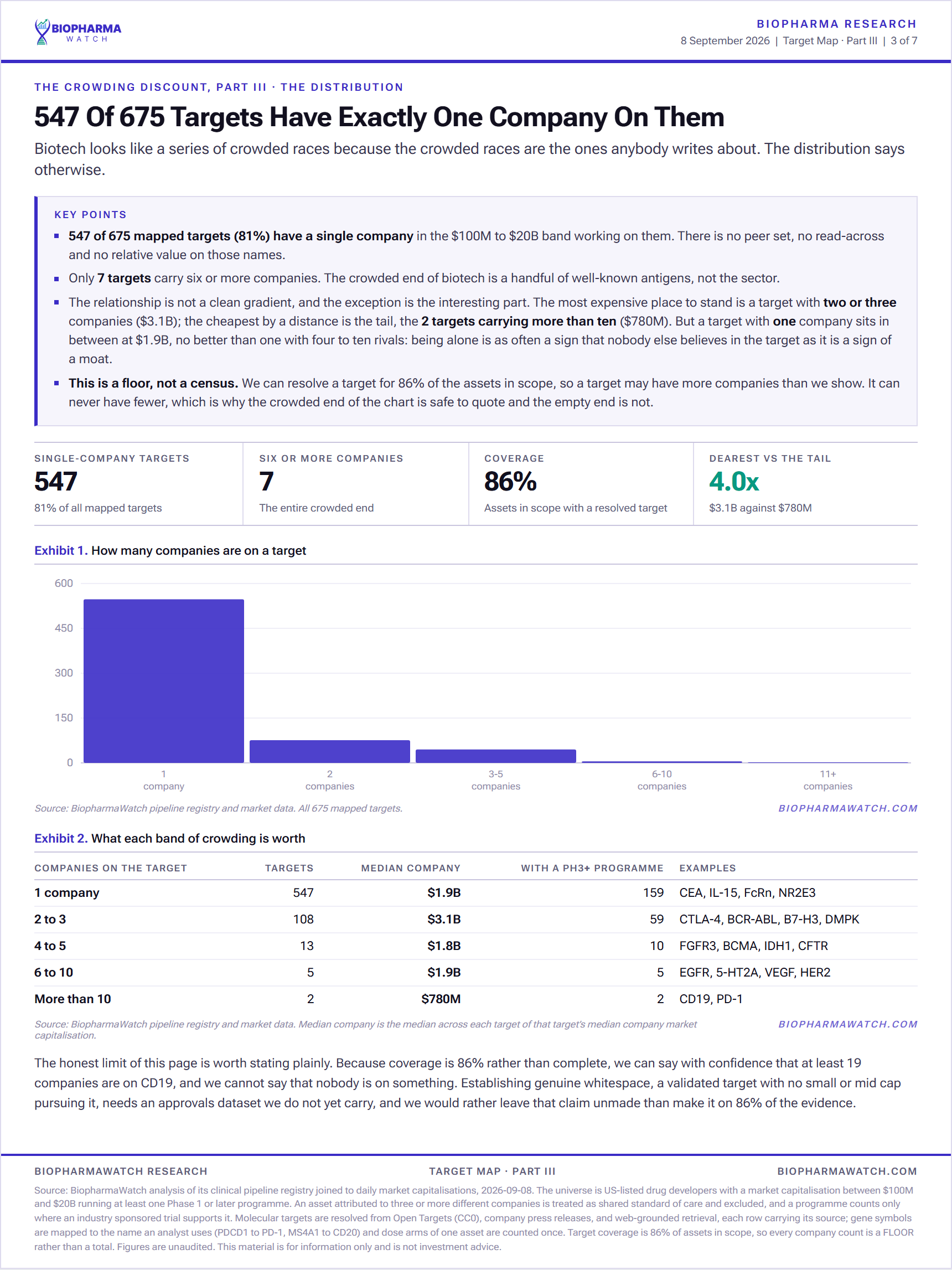
Usually one. Of 675 distinct molecular targets in this universe, 547 carry exactly one company, which is 81% of the map. Only 128 are contested by two or more companies, 20 carry four or more, and just 7 carry six or more.
A molecular target is the protein or gene a drug is designed to act on, so two companies on the same target are running the same scientific bet with different molecules. That matters if you value a clinical-stage company by comparison, because for most of this sector there is no peer set and no read-across. When nobody else is on your target, nothing else re-rates when you read out, in either direction.
The crowded races dominate the conversation because they are the ones people write about, not because they are typical.
Which molecular targets are the most crowded in biotech?
CD19 leads with 19 companies, followed by PD-1 with 13. Across the 52 targets carrying three or more companies there are 217 company programmes run by 141 distinct companies, and no other target in the band carries more than ten. The queues formed on molecules where the biology stopped being the risk, which leaves execution, manufacturing and label as the remaining variables.
Molecular target
Companies, $100M to $20B
In Phase 3 or later
Median company market cap
Who is on it
CD19
19
2
$600M
LYEL, ADCT, IBRX, CLYM, ALLO, AUTL, CABA and 12 more
PD-1
13
4
$780M
EXEL, SMMT, HCM, AGEN, ANAB, MGNX, CHRS and 6 more
EGFR
9
1
$1.4B
AVBP, BDTX, ERAS, VIR, BCAX, CGEM, ORIC and 2 more
5-HT2A
6
4
$2.7B
DFTX, ACAD, CMPS, HELP, TNXP, ATAI
VEGF
6
3
$780M
KOD, FDMT, EYPT, CORT, RGNX, ADAG
HER2
6
1
$1.9B
GLSI, MGNX, COGT, ELVN, VIR, FATE
GLP-1
6
2
$3.3B
AMLX, GPCR, KLRA, MIST, CYTK, BMEA
FGFR3
5
2
$2.4B
BMRN, ZYME, BBIO, TYRA, BHVN
BCMA
5
2
$280M
IMMX, RNAC, LKFT, DTIL, CRBU
IDH1
5
3
$2.1B
TNGX, NUVB, ZYME, SNDX, RIGL
Read the final column as a peer set. These are the companies whose shares move on the same scientific news, whatever disease each is chasing with it. A CD19 safety signal is a CD19 safety signal for all 19 of them, and LYEL, ADCT and ALLO do not get to opt out of it because their indication differs.
Does a crowded drug target mean the target is de-risked?
No. Company count measures attention, not evidence. 15 of the 52 targets with three or more companies have nobody past Phase 2 at all, so on those the crowd arrived before the proof did. Crowding and clinical depth are separate variables and they move independently here.
CD19 is the extreme case in both directions. 19 companies, 37 distinct assets, and only 2 of the 19 have reached Phase 3. More than a decade after the antigen was validated, most of the field is still in early trials.
The mirror image exists too. 3 targets have every single company already in Phase 3 or later: BTK, TTR, KLKB1. BTK is the clearest, with 4 companies and all 4 of them late stage, which makes it a contest about execution and label rather than about biology. NRIX, HCM, ZBIO, AAPG are the four running it.
Are companies on crowded targets cheaper?
At the extreme, yes. The 2 targets carrying more than ten companies have a median company worth $780M, against $3.1B for a target with two or three rivals. That is a 4.0x gap. Across the middle of the distribution there is no gradient at all, so crowding is priced at the tail rather than smoothly.
Companies on the target
Targets, n=675
Median company market cap
Share of companies in Phase 3+
Examples
1 company
547
$1.9B
29%
CEA, IL-15, FcRn, NR2E3
2 to 3
108
$3.1B
33%
CTLA-4, BCR-ABL, B7-H3, DMPK
4 to 5
13
$1.8B
34%
FGFR3, BCMA, IDH1, CFTR
6 to 10
5
$1.9B
33%
EGFR, 5-HT2A, VEGF, HER2
More than 10
2
$780M
19%
CD19, PD-1
The row that surprises people is the first. Being alone is not a moat. The 547 single-company targets carry a median of $1.9B, no better than a target with four to ten rivals on it. Nobody else being there is as often a verdict on the target as it is an opportunity in it, and the market prices it that way.
The obvious follow-up is which individual companies look mispriced against the crowding on their own target. That is a valuation question rather than a counting one, and the per-company valuation score, cash position and dilution risk are subscriber fields. A free trial opens them for all 335 companies here.
Median company is computed within each target and then across targets, so a target counts once however many companies stand on it. Pooling every company into one median instead lets CD19 and PD-1, which carry 32 companies between them, dominate the answer.
Which antibody-drug conjugate and payload targets are contested?
10 antigen and payload targets carry three or more companies each. An antibody-drug conjugate, or ADC, is an antibody that carries a cytotoxic payload to a tumour antigen, so the contest runs on two axes at once: which antigen you bind, and which payload chemistry you attach to it.
Nectin-4 is the most contested antigen in the group at 4 companies with a median company of $220M, the cheapest field in this table. The payload side behaves differently: the topoisomerase targets TOP1 and TOP2A and the proteasome are shared chemistry rather than shared biology, which is why the same names keep reappearing across those rows.
How much cash do the companies in these races actually have?
33 of 233 cash-burning companies in this universe have less than twelve months of runway at their current burn rate, and 12 of those are running a Phase 3. Runway is cash and equivalents divided by monthly operating burn at the latest reported quarter. It sets the date by which a company must read out, raise, partner or sell.
This is where a competitive map stops being academic. A company on a crowded target with a short runway negotiates from the weakest possible position, because the counterparty can see the same date.
The three tightest of those 12, each running a Phase 3 on under a year of cash:
Runway, monthly burn and dilution risk for the full 33 sit behind the paywall, alongside the same fields for every company in the 335-company universe. Open a free trial if you want the whole list rather than the three above.
Profitable companies are excluded from every runway figure here. Cash divided by a loss they are not making produces a number with no meaning, and leaving them in puts Halozyme at $12.5 billion on an apparent 5.6 months of runway. On the same population the unfiltered count is 43 and the real one is 33. Of the difference, five are confirmed profitable and five carry no profitability flag, so they are held out rather than assumed either way.
How many of these companies are one drug away from nothing?
139 of 335 companies in this universe hold exactly one clinical asset, and 57 of those have already taken it into Phase 3. For those 57, the readout is the company. There is no second programme to fall back on, only cash and a decision about what to do next.
The market prices that difference cleanly, and this is the one relationship in the whole dataset that does not reverse at any step.
Distinct clinical assets
Companies, n=335
Median market cap
With a Phase 3 asset
1 asset
139
$634M
57
2
62
$923M
30
3 to 4
73
$1.3B
45
5 to 8
38
$1.7B
29
9 or more
23
$1.9B
20
Causation runs both ways, and the honest reading is that a company which has already succeeded can afford a second programme. What the ladder does establish is the size of the discount for being binary. At the other end, 23 companies carry nine or more distinct clinical assets, led by ADPT, DTIL, SNDX, IBRX, JAZZ, and those are the names with multiple product launches plausibly ahead of them rather than a single outcome.
Who is betting against the crowded races?
88 companies in this universe have more than a fifth of their tradable float sold short, and 25 are above 30%. Short interest in small-cap biotech is more often a financing trade or a convertible hedge than a scientific view, but it marks where the other side of the table has concentrated.
The number that turns a crowded short into a violent one is days to cover, which is short interest divided by average daily volume. 59 of the 88 sit above ten days. That is the combination where an unexpected positive readout has nowhere to clear, because the position cannot be bought back quickly at a sensible price.
The most heavily shorted names in the set are VOR at 56%, SION at 51%, CAPR at 43%, SGMT at 42%, RXRX at 41%, ZBIO at 40%. Short interest is reported to FINRA twice a month and reaches us with roughly a two to three week lag, so read it as positioning rather than as live information.
Which of these companies have a dated FDA decision coming?
34 FDA decisions across 32 companies in this universe carry a real calendar date inside the next twelve months. A dated decision is the only catalyst in biotech with a deadline the company does not control, which is what separates it from a readout, an enrolment update or a partnership announcement.
That calendar is shorter than it first appears, and the reason is worth stating. The source data marks 238 forward events as day-precision, but 90 of them fall on 31 December, which is a year-end placeholder rather than a scheduled decision. Taking that field at face value draws a wall of December decisions that does not exist. What survives the filter is 34 real dates. The full forward book sits on the FDA calendar.
How did we measure this?
The universe is every US-listed drug developer with a market capitalisation between $100 million and $20 billion running at least one Phase 1 or later programme, measured on 8 September 2026. That produced 1,321 proprietary clinical-stage assets, of which 1,136, or 86%, have a resolved molecular target.
Three gates run before anything is counted, and the first matters most:
Drug developers only, by SIC code and industry classification, with a reviewed denylist for contract research organisations, diagnostics and tools companies. A trial registry stamps a sponsor ticker onto every intervention in a matched trial, so without this gate you count whoever ran the trial rather than whoever owns the asset. An earlier build of this analysis counted ICON plc, a contract research organisation, as the twentieth company racing on CD19.
Shared standard of care excluded. An asset attributed to three or more different companies is a comparator or a backbone, not one company's own programme.
Industry-sponsored trials only. An investigator-initiated academic study of a third-party drug is not that company's pipeline.
Beyond the gates, gene symbols map to the name an analyst uses, so PDCD1 becomes PD-1 and MS4A1 becomes CD20, pan-family gene lists collapse to a single mechanism, and a company's dose arms of one asset count once rather than as separate programmes. Trial records come from ClinicalTrials.gov, financials from SEC filings, and market capitalisations are same-day.
What are the limits of this analysis?
Molecular target resolves for 86% of the assets in scope, so every company count here is a floor: at least this many, never fewer. That asymmetry is the reason the crowded end of the chart is safe to quote and the empty end is not.
We can say with confidence that at least 19 companies are on CD19. We cannot say that nobody is on something. Establishing genuine whitespace, a validated target with no small or mid cap company pursuing it, needs an approvals dataset we do not yet carry, and we would rather leave that claim unmade than make it on 86% of the evidence.
Two further limits are worth naming. Companies above $20 billion sit outside the universe by construction, so a target can look thin here while a large-cap runs three programmes against it. And short interest, runway and market capitalisation all move faster than a pipeline does, so the competitive structure on this page ages more slowly than the prices attached to it.
This material is for information only and is not investment advice or a recommendation to buy or sell any security. Market capitalisations, short interest and competitive structures change; the analysis is rebuilt from current filings and trial records rather than frozen.
Frequently asked questions
What is the most crowded drug target in biotech?›
CD19, with 19 US-listed drug developers between $100 million and $20 billion running a clinical programme against it, spread across 37 distinct assets. PD-1 is second with 13 companies. Both are antigens validated more than a decade ago, and both are cheap per company: the median company standing on a target with more than ten rivals is worth $780M. No other target in the band carries more than ten companies.
How many companies compete on the average molecular target?›
One. Of 675 distinct molecular targets mapped, 547 have exactly one company on them and only 128 are contested by two or more. Just 20 carry four or more companies and only 7 carry six or more. The crowded races get written about far more often than they occur, which makes the sector look more contested than it is.
Does a crowded drug target mean the target is validated?›
No, and the data separates the two clearly. 15 of the 52 targets with three or more companies have nobody past Phase 2 at all, so the crowd arrived before the proof did. CD19 has 19 companies and only 2 in Phase 3 or later. The opposite also happens: 3 targets have every single company already in Phase 3, BTK, TTR, KLKB1, which makes those races contests about execution and label rather than about biology.
Are companies on crowded targets cheaper?›
At the extreme, yes. The 2 targets with more than ten companies carry a median company of $780M against $3.1B for a target with two or three, a 4.0x gap. In the middle there is no gradient at all: four to five companies gives $1.8B and six to ten gives $1.9B, both close to the $1.9B that a single-company target carries. Crowding is priced at the tail, not smoothly.
Is a target with no competition worth more?›
Usually not. The 547 targets with a single company carry a median company market capitalisation of $1.9B, which is lower than the $3.1B on targets with two or three companies. A second or third credible company entering is a signal that the mechanism is believed; being alone is as often a sign that nobody else thinks the target is worth pursuing as it is a sign of a defensible position.
How are the company counts calculated, and what is excluded?›
Three gates run before anything is counted: drug developers only by SIC code and industry classification with a reviewed denylist for CROs, diagnostics and tools companies; assets attributed to three or more different companies are treated as shared standard of care and dropped; and only industry-sponsored trials count, so an investigator-initiated academic study of a third-party drug is not counted as that company's pipeline. Gene symbols are mapped to analyst names, PDCD1 to PD-1 and MS4A1 to CD20, pan-family gene lists collapse to one mechanism, and a company's dose arms of one asset are counted once.
How complete is the target coverage?›
A molecular target resolves for 86% of the 1,321 proprietary clinical-stage assets in scope, which is 1,136 assets across 675 targets. Every company count is therefore a floor rather than a total: a target may have more companies on it than shown, never fewer. That is why this analysis makes claims about the crowded end of the distribution and deliberately makes none about genuine whitespace, which would need an approvals dataset we do not carry.