Biotech Anatomy 2026: What 1,640 Readouts Really Paid
BWBiopharmaWatch Research··13 min read
Biotech data readouts are called positive 91% of the time, yet the stock rose on fewer than half of those days: 47%. That gap between what a company says and what the market pays is the thread running through The Biotech Anatomy 2026, our new report on 1,640 readouts from 394 companies, 373 first FDA decisions on new drugs, 15,697 pipeline assets and $137 billion held by 45 specialist biotech funds.
The report has ten findings, one per slide, and each is cut by disease area and by drug type. Some confirm what investors suspect, such as how often first-time sponsors stumble at the FDA. Others are harder to see without the data side by side, such as how quickly a company sells stock after a big jump, or how little a fund's 13F tells you before a binary event. Below is every finding in plain words, with the charts. The full 18-page PDF is free at the end of this post.
Who owns each disease area in biotech?
It depends sharply on the disease. In infectious disease, big pharma (companies worth more than $50 billion) holds 78% of active programmes. GSK alone runs 40 of them, mostly vaccines. Respiratory (63%) and renal (65%) look much the same: a few large owners and few independent biotechs.
Rare disease is the opposite. Big pharma holds only 24% of active rare-disease programmes, and psychiatry, neurology and ophthalmology are also biotech ground, with companies under $50 billion holding two-thirds or more of the work.
Oncology is the most crowded field and the most fragmented. It has 1,102 active assets across 219 companies. Outside big pharma, 532 assets sit with 201 biotechs, and the five largest of those hold only 18%. For an investor, that means an oncology biotech almost always has several direct rivals chasing the same patients, which matters later in this report when we look at valuations.
Which disease areas get drugs from Phase 2 to Phase 3?
Phase 2 is where disease areas split apart. Across all areas, 31% of programmes moved from Phase 1 to Phase 2 and 21% from Phase 2 to Phase 3. Immunology advanced most often: 33% of its Phase 2 programmes reached Phase 3. Oncology was second at 30%, which surprises people given how crowded it is.
Gastrointestinal drugs did worst, at 8%. Respiratory and ophthalmology also stall at Phase 2. The gastrointestinal programmes that did advance spent a median 44 months in Phase 2, close to four years. When a GI biotech says it is "preparing for Phase 3", history says to expect a long wait and a low hit rate.
Do antibodies or small molecules reach Phase 3 more often?
Antibodies, by a wide margin. 82 of 258 antibody Phase 2 programmes reached Phase 3 (32%), against 235 of 1,333 small molecules (18%). An antibody usually starts from a target the field already understands, and it has fewer off-target surprises, so fewer programmes fail on safety or on a weak effect.
Gene therapy is slow before it is risky. It spent a median 44 months in Phase 1, twice the 22 months of a small molecule. Vaccines advanced least often, 20% from Phase 1.
Company size matters too. Biotechs carry Phase 1 programmes forward more often than big pharma (35% against 27%), because big pharma starts more programmes and prunes them early, while a company with one or two drugs keeps going. By Phase 2 the two land in the same place: 21% each.
How often do first-time FDA sponsors get a complete response letter?
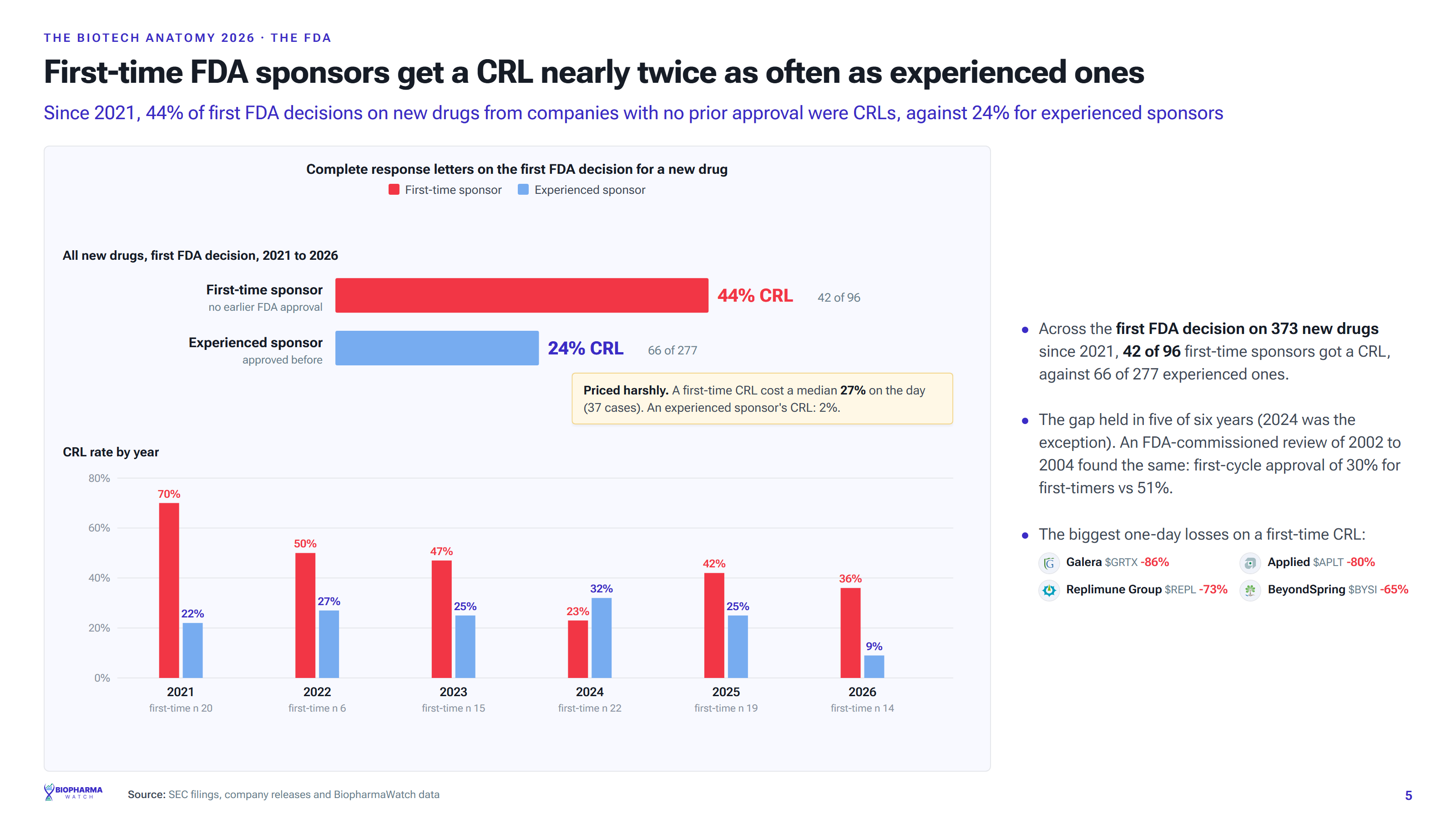
Nearly twice as often as experienced companies. Across the first FDA decision on 373 new drugs since 2021, 42 of 96 first-time sponsors got a complete response letter (CRL), 44%. Experienced sponsors got one 66 of 277 times, 24%. The gap held in five of the six years; 2024 was the only exception. An FDA-commissioned review of 2002 to 2004 found the same pattern, with first-cycle approval of 30% for first-timers against 51%.
The market prices a first-time CRL harshly. Across 37 cases, it cost a median 27% on the day. An experienced sponsor's CRL cost a median 2%. The worst one-day losses on a first-time CRL were GRTX Galera at minus 86%, APLT Applied Therapeutics at minus 80%, REPL Replimune at minus 73% and BYSI BeyondSpring at minus 65%.
Drug type widens the gap. A biologic is approved together with its factory: the FDA inspects the plant before it licenses the product, and a first-time sponsor usually depends on a contract manufacturer it has never filed with. 13 of 22 first-time biologics got a CRL (59%), against 18 of 45 first-time small molecules (40%). Experienced sponsors show the same gap, 31% against 18%. RNA drugs were the cleanest of all, with 2 CRLs in 12 decisions, nearly all from experienced sponsors.
Which disease area gets the most FDA rejections?
Neurology. 17 of 39 neurology drugs got a CRL at their first decision, 44%, three times the 13% rate in infectious disease. For first-time neurology sponsors it was 7 of 10. Neurology endpoints are rating scales and symptoms rather than tumour size or viral load, so the FDA has more room to question whether the effect is real and meaningful. Dermatology and endocrine also sit above 40%.
Oncology, with the most crowded pipeline, sits near the average: 18 of 66, or 27%. Real-time oncology review and accelerated approval let sponsors fix problems with the FDA before the review clock starts. Renal looks safe at 20% overall, but 4 of its 5 first-time sponsors got a CRL. These samples are small, so the PDF shows the count next to every bar. If you follow upcoming decisions, the FDA calendar lists every PDUFA date we track.
Do biotech stocks rise after positive data readouts?
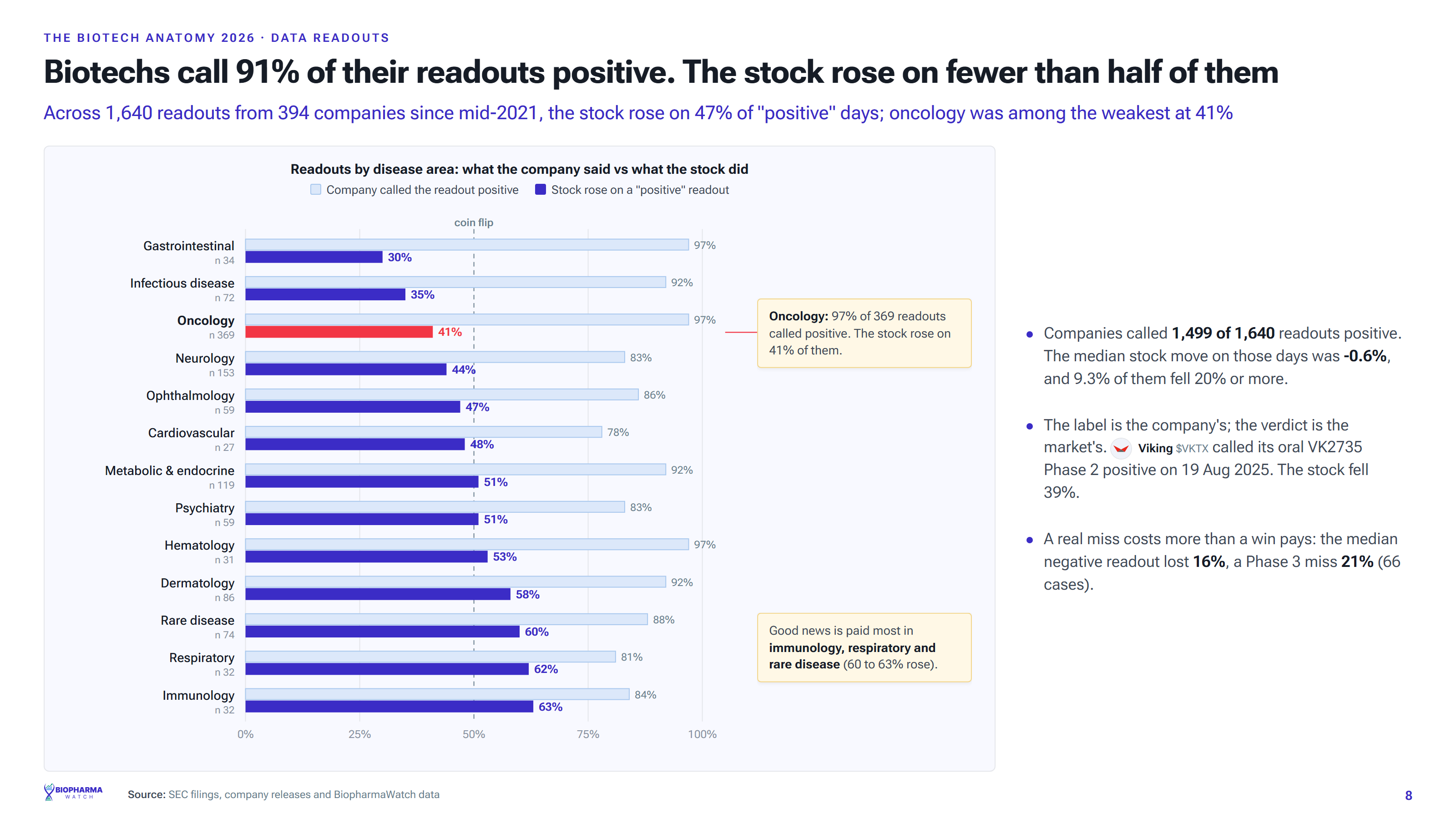
Less than half the time. Companies called 1,499 of 1,640 readouts positive, and the median stock move on those days was minus 0.6%. On 9.3% of "positive" days the stock fell 20% or more. The label is the company's; the verdict is the market's.
One example: VKTX Viking Therapeutics called the Phase 2 study of its oral VK2735 positive on 19 August 2025. The stock fell 39% that day.
Oncology is the clearest case. Companies called 97% of 369 oncology readouts positive, and the stock rose on only 41% of them. Good news was paid best in immunology, respiratory and rare disease, where the stock rose on 60 to 63% of positive days. A real miss costs more than a win pays: the median negative readout lost 16%, and a Phase 3 miss lost a median 21% across 66 cases.
Which trial phase moves biotech stocks the most?
Phase 3, in both directions. 440 of 444 Phase 1 readouts were called positive, 99%, because a Phase 1 study is mostly about safety and almost every release reads as good news. The stock rose on 48% of them.
Phase 3 is the only stage where good news lifted the stock more often than not, at 51%. The payoff is lopsided. A positive Phase 3 day in the top tenth gained 23% or more, while a Phase 3 miss had a one-in-three chance of halving the stock: 33% of misses lost 50% or more. This is why biotechs trade like options into data. Many small wins are already in the price, and the loss on a miss is several times the gain on a win.
By drug type, companies almost never call a gene therapy or cell therapy readout negative: one negative in 51 gene therapy readouts and none in cell therapy. The stock rose on about 42% of them. Every vaccine readout was called positive, and the stock rose on 8 of 32. When a small molecule misses, it misses hard: 38% of small-molecule misses lost half the company's value, against 28% for antibodies.
How often do biotechs sell stock after a big jump?
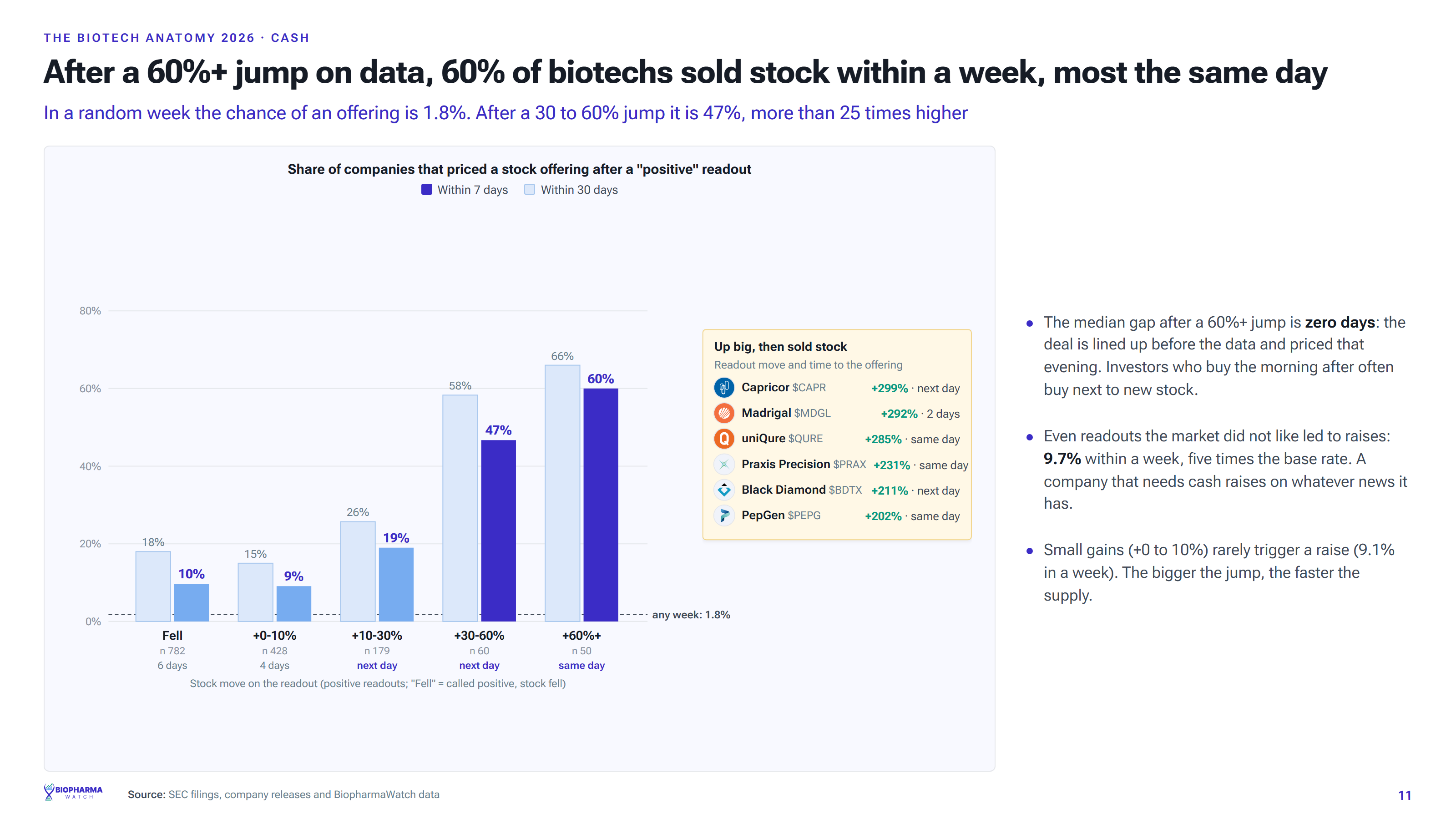
Very often, and very fast. After a jump of 60% or more on data, 60% of biotechs sold stock within a week, most on the same day. In a random week, the chance of an offering is 1.8%. After a 30 to 60% jump it is 47%, more than 25 times higher.
The median gap between a 60%-plus jump and the offering is zero days. The deal is lined up before the data and priced that evening, which means investors who buy the morning after often buy next to new stock. CAPR Capricor rose 299% on its deramiocel data in December 2025 and sold stock the next day. QURE uniQure (up 285%) and PRAX Praxis Precision (up 231%) both sold stock the same day.
Even readouts the market did not like led to raises: 9.7% within a week, five times the base rate. A company that needs cash raises on whatever news it has. Small gains of 0 to 10% rarely led to a raise (9.1% in a week). The bigger the jump, the faster the new supply. If you hold small-cap biotechs into data, the biotech screener shows cash runway, which is the best single hint of who will raise next.
How many biotech stocks trade below cash?
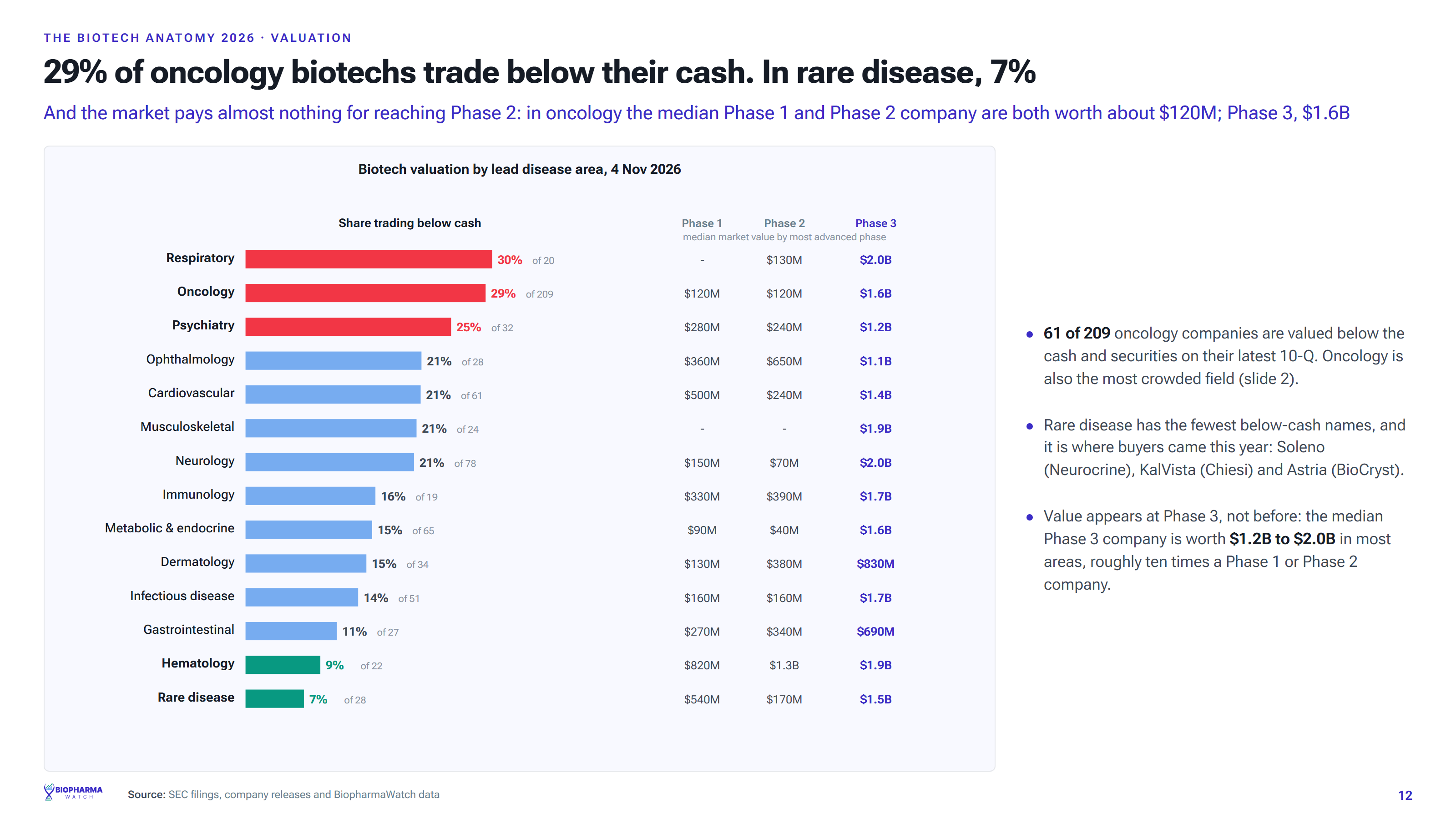
In oncology, almost a third. 61 of 209 oncology companies, 29%, are valued below the cash and securities on their latest 10-Q. In rare disease it is 7%, the lowest of any area, and rare disease is where buyers came this year: SLNO Soleno (bought by NBIX Neurocrine), KALV KalVista (Chiesi) and ATXS Astria (BCRX BioCryst).
The market also pays almost nothing for reaching Phase 2. In oncology, the median Phase 1 company and the median Phase 2 company are both worth about $120 million. The median Phase 3 oncology company is worth $1.6 billion. Across most areas, the median Phase 3 company is worth $1.2 billion to $2.0 billion, roughly ten times a Phase 1 or Phase 2 company. Value appears at Phase 3, not before.
Where are specialist biotech funds putting new money?
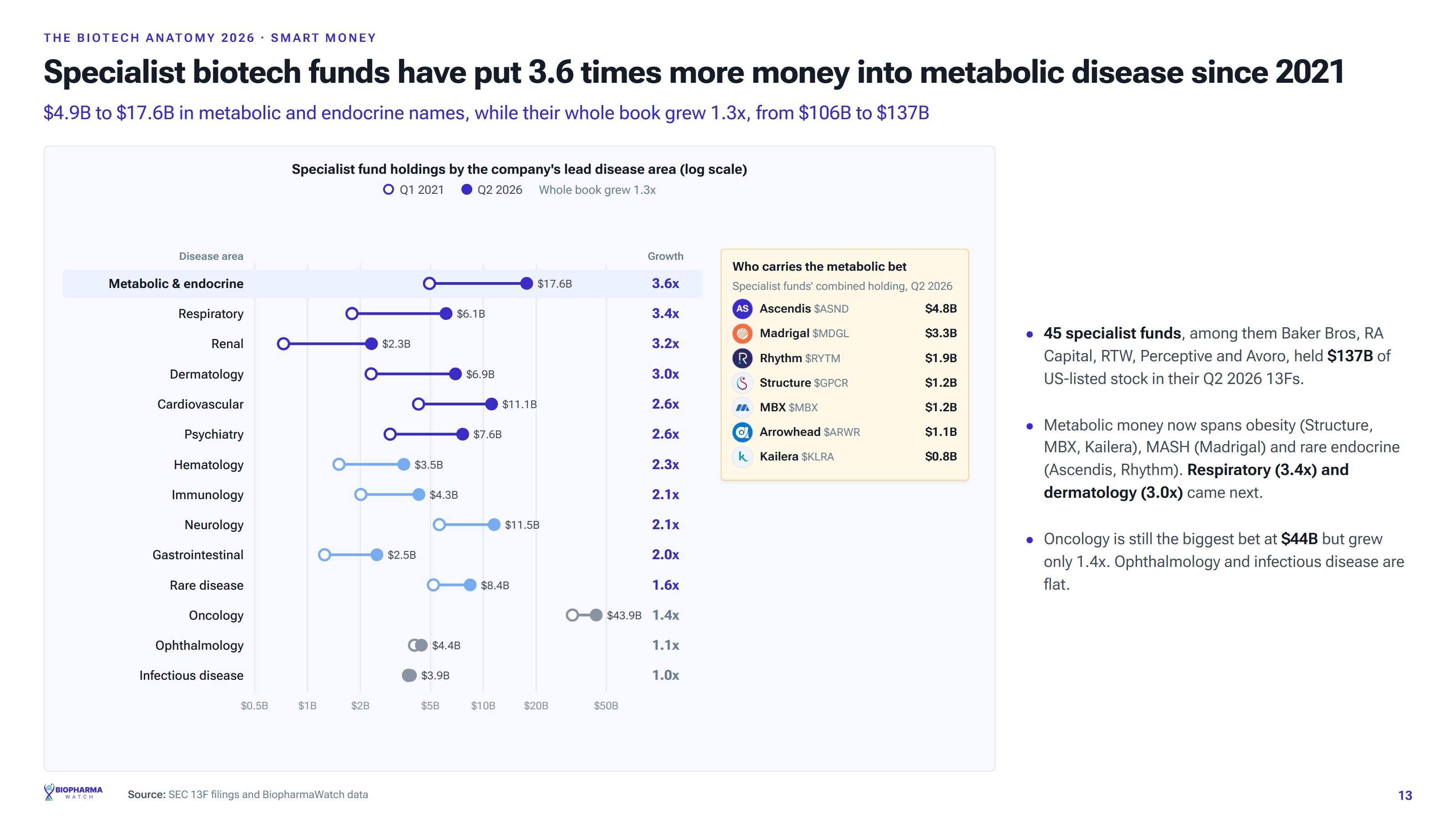
Into metabolic disease. 45 specialist funds, among them Baker Bros, RA Capital, RTW, Perceptive and Avoro, held $137 billion of US-listed stock in their Q2 2026 13F filings. Their money in metabolic and endocrine names rose from $4.9 billion in 2021 to $17.6 billion, 3.6 times, while their whole book grew 1.3 times, from $106 billion.
The metabolic bet spans obesity (GPCR Structure, MBX MBX Biosciences and Kailera), MASH (MDGL Madrigal) and rare endocrine (ASND Ascendis, the largest metabolic holding at $4.8 billion, and RYTM Rhythm). Respiratory (3.4 times) and dermatology (3.0 times) grew next fastest. Oncology is still the biggest bet at $44 billion, but it grew only 1.4 times. Ophthalmology and infectious disease were flat.
The biggest new money in Q2 2026 went into brand-new positions. 9 funds opened Parabilis in the same quarter, $0.97 billion, while 5 opened Kailera and 7 opened Hemab. The most widely held names are RVMD Revolution Medicines and COGT Cogent, with 19 funds each, followed by precision oncology such as ELVN Enliven and immunology names such as DNTH Dianthus and ABVX Abivax. A stock held by 15 to 19 specialist funds has many informed holders and few marginal buyers left, which matters when it reports.
What were the biggest biotech takeouts for specialist funds?
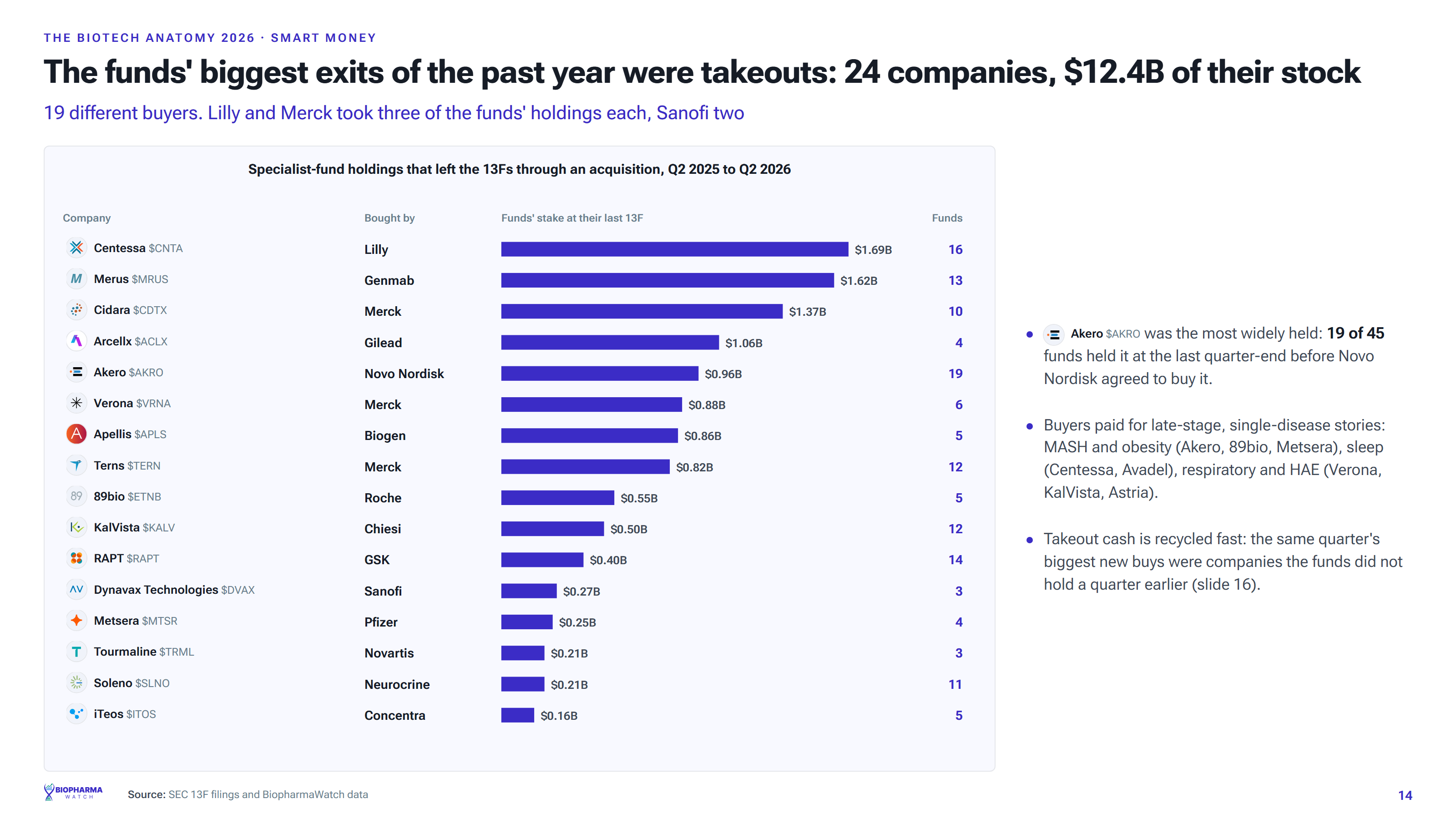
The funds' biggest exits of the past year were not sales. They were takeouts: 24 companies, $12.4 billion of the funds' stock, bought by 19 different buyers. LLY Eli Lilly and MRK Merck each took three of the funds' holdings, and SNY Sanofi took two.
AKRO Akero was the most widely held: 19 of the 45 funds owned it before NVO Novo Nordisk agreed to buy it. Buyers paid for late-stage, single-disease stories: MASH and obesity (Akero, ETNB 89bio and MTSR Metsera), sleep (CNTA Centessa and AVDL Avadel), and respiratory and HAE (VRNA Verona, KalVista and Astria). Takeout cash is recycled fast: the same quarter's biggest new buys were companies the funds did not hold a quarter earlier.
Do hedge funds sell before bad FDA news?
No. Before a CRL, the specialist funds had cut the stock 37% of the time. Before an approval, 36%. Before a failed readout they cut 21% of the time, and before a readout that jumped 10% or more, 22%. Across 1,389 events, the share of cuts is flat across good and bad outcomes, with rare exceptions such as AMLX Amylyx.
That fits how these funds work. They size into binary events with a view, and a 13F is up to 135 days old by the time anyone reads it. It shows what they own, not what they know. Copying a fund's 13F is a way to find names worth researching, not a signal about the next readout or PDUFA date.
Does the CRO and CDMO sector lead biotech spending?
No. We looked at 13 CRO, CDMO and bioprocess companies against biotech R&D spending. They all peaked with biotech R&D in 2021 and slowed with it. Before 2023 the same-quarter link was strong: IQVIA 0.74, ICON 0.86, Repligen 0.72 and Bio-Techne 0.83. Since then, only ICLR ICON (0.87) and MEDP Medpace (0.80) still move with biotech R&D.
No lead held up. Medpace's three-quarter lead fell from 0.64 in 2019 to 2022 to 0.28 in 2023 to 2026, and the two companies whose lead rose (ICON and EBS Emergent) were weak or negative before 2023. Manufacturing had the deeper bust: the bioprocess median went from plus 29% to minus 8%, and CDMOs to minus 12%, as COVID-era stock was used up, even though biotech R&D never shrank (its low was plus 0.1%). Medpace is the outlier at plus 25% revenue growth against a CRO median of plus 3%, and its 2026 rebound is its own, not the sector's. IQV IQVIA, RGEN Repligen and TECH Bio-Techne each have their own page with filings and news.
What should biotech investors take from this?
Five things stand out across the ten findings.
Read the market, not the press release. 91% of readouts are called positive; fewer than half lift the stock.
A first-time sponsor with a biologic is the riskiest FDA setup in the data: a CRL 59% of the time, and a median 27% one-day loss when it comes.
Expect new stock after a big jump. After a 60%-plus move, 60% of companies sold stock within a week, and the median raise came the same day.
Value arrives at Phase 3. Before that, the market pays little for progress, especially in crowded oncology, where 29% of companies trade below cash.
Specialist funds are crowding into metabolic disease, and their biggest exits are takeouts, but their 13Fs do not warn of bad news.
None of this is investment advice. It is a map of how biotech has behaved since 2021, cut by disease and drug type, so you can judge a single stock against its own base rate.
Every company named here has its own page on BiopharmaWatch with its pipeline, catalysts, cash runway and recent news. The FDA calendar lists every upcoming PDUFA date, and the biotech screener covers more than 900 drugmakers. Subscribers also see the modeled probability of approval for each drug, insider activity and hedge fund holdings; you can start a free trial to see them. For more research like this, read our Disease Map of where smaller companies compete by indication.
Frequently asked questions
How often do biotech stocks rise after positive data?›
On 47% of days a company called its readout positive, across 1,640 readouts from 394 companies since mid-2021. The median move on those days was -0.6%.
Do first-time FDA sponsors get more complete response letters?›
Yes. Since 2021, 44% of first FDA decisions on new drugs from companies with no prior approval were CRLs, against 24% for experienced sponsors. The gap held in five of six years.
How often do biotechs raise money after a stock jump?›
After a jump of 60% or more on data, 60% sold stock within a week and the median raise came the same day. In a random week the chance of an offering is 1.8%.
How many biotech stocks trade below cash?›
61 of 209 oncology companies, 29%, are valued below the cash and securities on their latest 10-Q. In rare disease it is 7%.
Do specialist biotech funds sell before bad FDA news?›
No. They cut the stock before 37% of CRLs and 36% of approvals. A 13F is up to 135 days old when read, so it shows what funds own, not what they know.
Is the Biotech Anatomy 2026 report free?›
Yes. The 18-page PDF is free to download from this post, with no signup.