Big Pharma Q3 2026 Earnings Ranked: Lilly Takes the Growth
BWBiopharmaWatch Research··10 min read
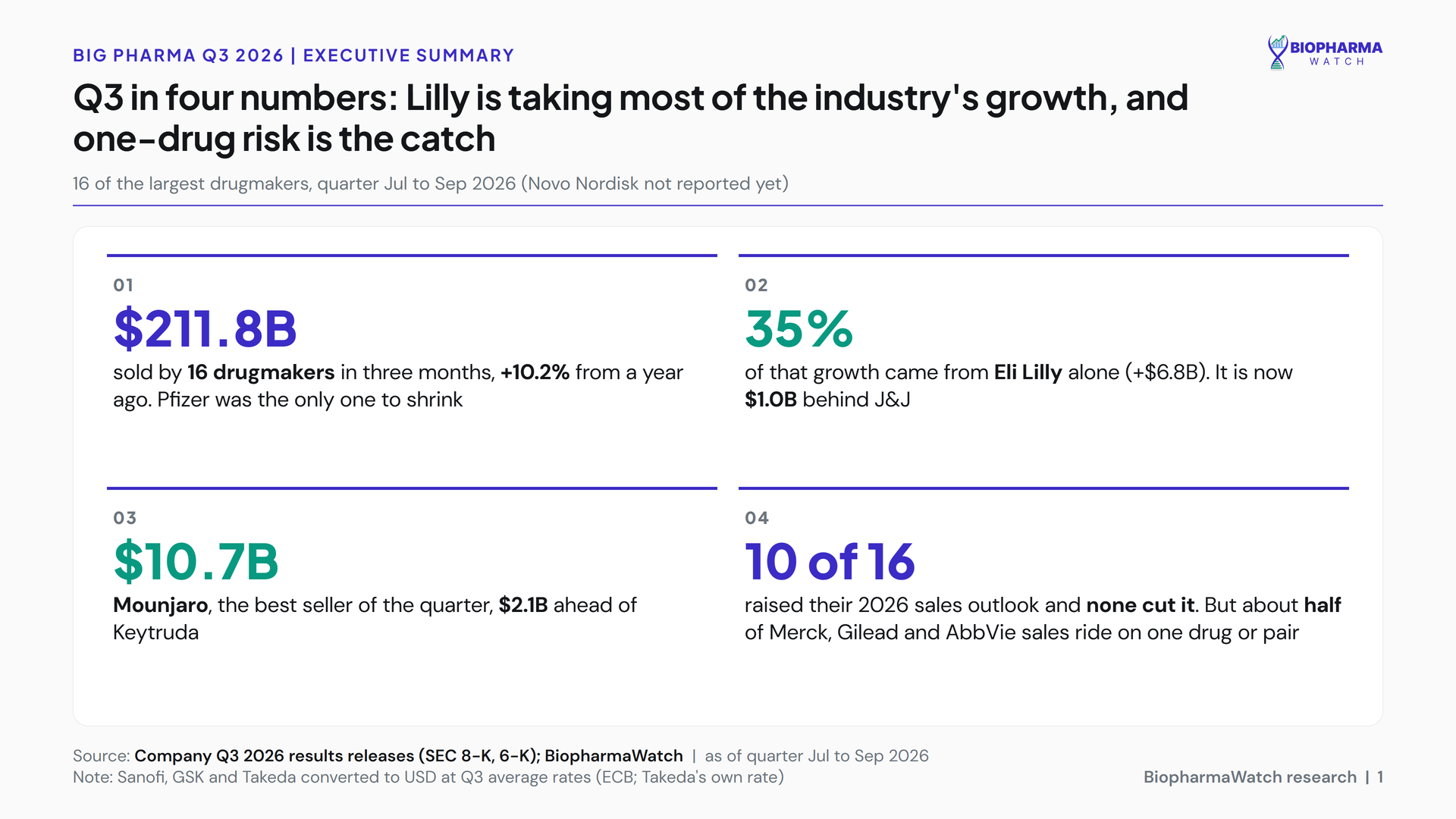
Big Pharma Q3 2026 earnings came in at $211.8 billion of revenue across 16 of the largest drugmakers, up 10.2% from a year earlier, and one company took more than a third of that growth. LLY Eli Lilly added $6.8 billion of quarterly sales in a year, 35% of the $19.6 billion the whole group added, and its Mounjaro made $10.7 billion in three months, $2.1 billion more than Keytruda.
We read every third quarter results release these companies filed with the SEC, line by line, and put them on one table: revenue, growth, the drugs that moved, the guidance changes and how much each company now leans on a single product. Novo Nordisk reports on November 5 and is not in these numbers yet; we will add it when it does. Everything below covers the quarter from July to September 2026.
Which pharma company had the highest revenue in Q3 2026?
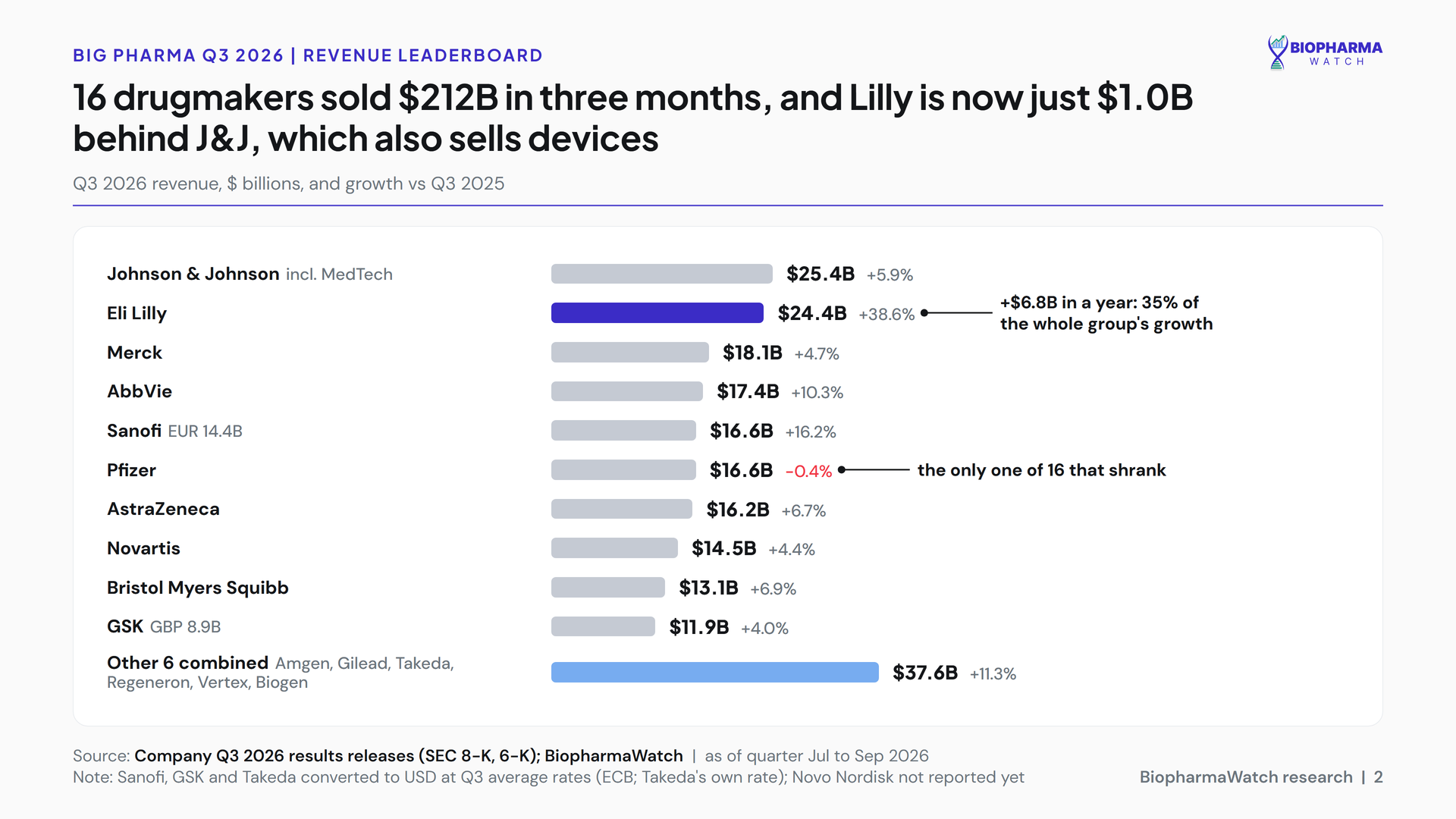
Johnson & Johnson, at $25.4 billion, but the gap is now small and the comparison flatters it. JNJ reports medical devices inside that figure. Eli Lilly, a pure drugmaker, came in at $24.4 billion, just $1.0 billion behind. On medicines alone, Lilly was the largest company on this list for the quarter.
Most of the list grew between 4% and 10%, which is about what you would expect from mature drugmakers with patents rolling off every year. Sanofi was the standout among the European names at +16.2%, helped almost entirely by Dupixent. Takeda's +6.7% is a currency story: at constant exchange rates its revenue fell 1.6%, because the yen averaged about 160 to the dollar against 146 a year ago.
How much did Eli Lilly grow in Q3 2026?
Lilly's revenue rose from $17.6 billion to $24.4 billion, a gain of 38.6% and $6.8 billion in a single year-over-year quarter. To put that in proportion: the extra money Lilly made this quarter is more than Vertex and Biogen sell in a whole quarter combined ($6.24 billion).
The growth is volume, not price. Lilly's own release says realized prices fell 15% worldwide, and 29% outside the US, where China added Mounjaro to its national reimbursement list. More patients are taking the drugs at lower prices per dose. About $900 million of the quarter was one-time help, including $410 million of Jardiance milestones, so the underlying growth is a little lower than the headline but still far ahead of everyone else.
Lilly also raised its full-year 2026 revenue forecast to $91 billion to $92 billion, from $85 billion to $87 billion in the summer. That is a $5.5 billion raise at the midpoint, the biggest move of any company this season.
Where did Big Pharma's revenue growth come from?
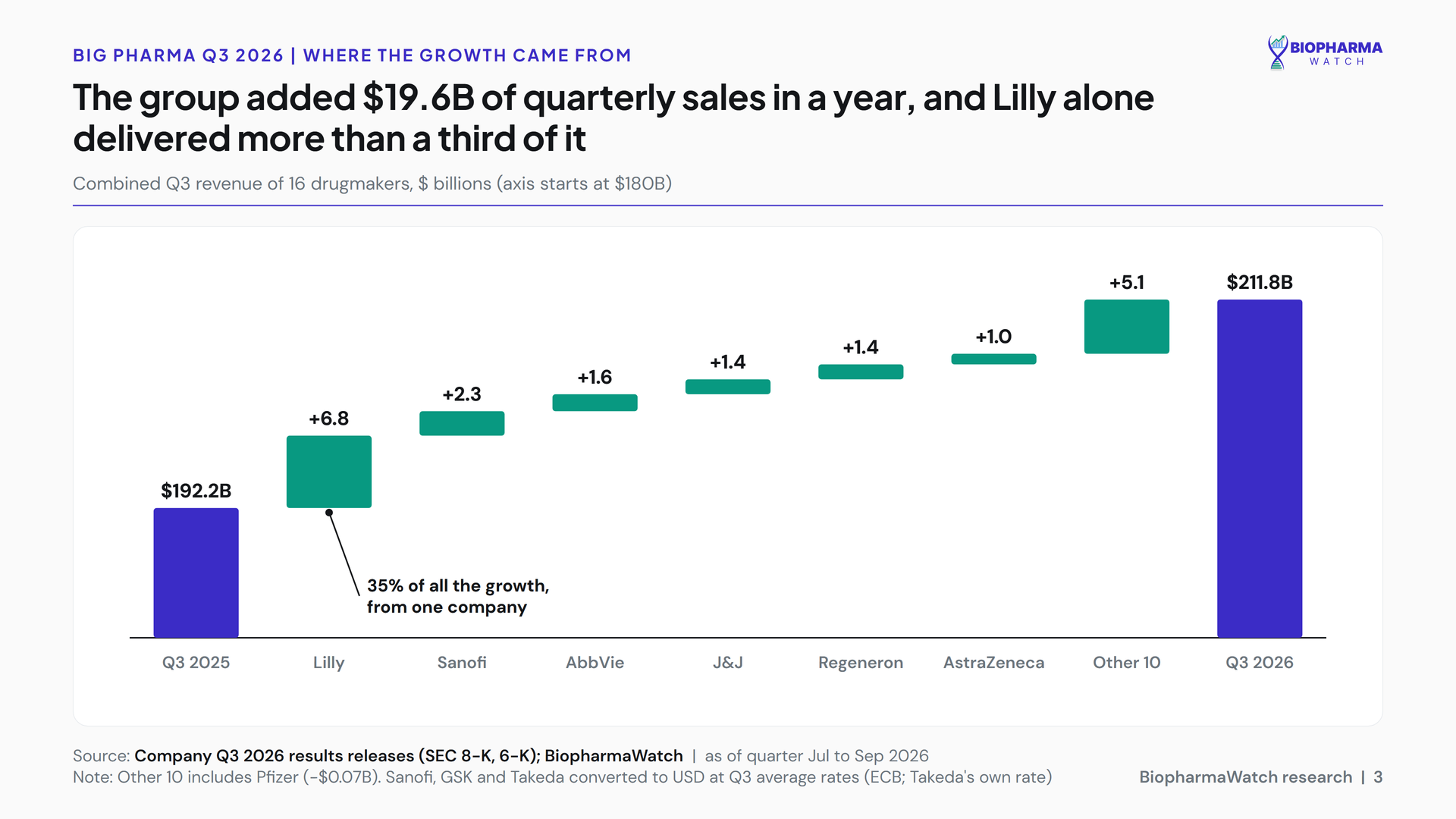
The 16 companies sold $192.2 billion in Q3 2025 and $211.8 billion in Q3 2026. Here is how the $19.6 billion difference splits:
Eli Lilly: +$6.8B, 35% of the total
Sanofi: +$2.3B
AbbVie: +$1.6B
Johnson & Johnson: +$1.4B
Regeneron: +$1.4B
AstraZeneca: +$1.0B
The other 10 combined: +$5.1B, after Pfizer's small decline
One company added more than the bottom ten put together. That is the single most useful number in this earnings season, because it tells you how concentrated the industry's growth has become.
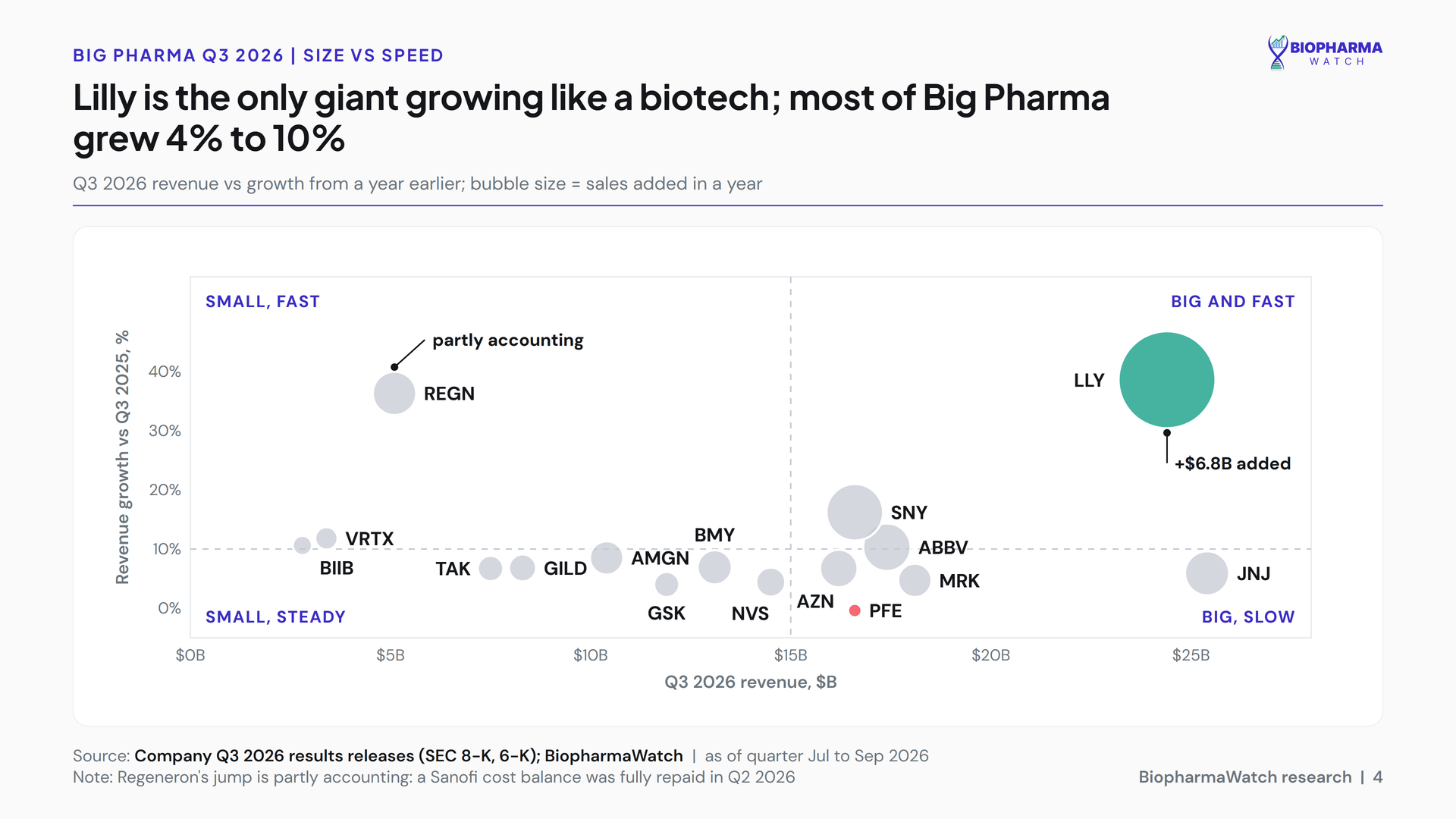
Plot size against speed and the picture gets even clearer. Almost every large company sits in a flat band of 4% to 10% growth. Lilly is the only giant growing like a mid-cap biotech. Regeneron also jumped 36%, but its release explains that part of that is accounting: a development balance it owed Sanofi was fully repaid in Q2 2026, so it stopped reducing Regeneron's collaboration revenue. Not all of that jump is new demand.
What was the best-selling drug in Q3 2026?
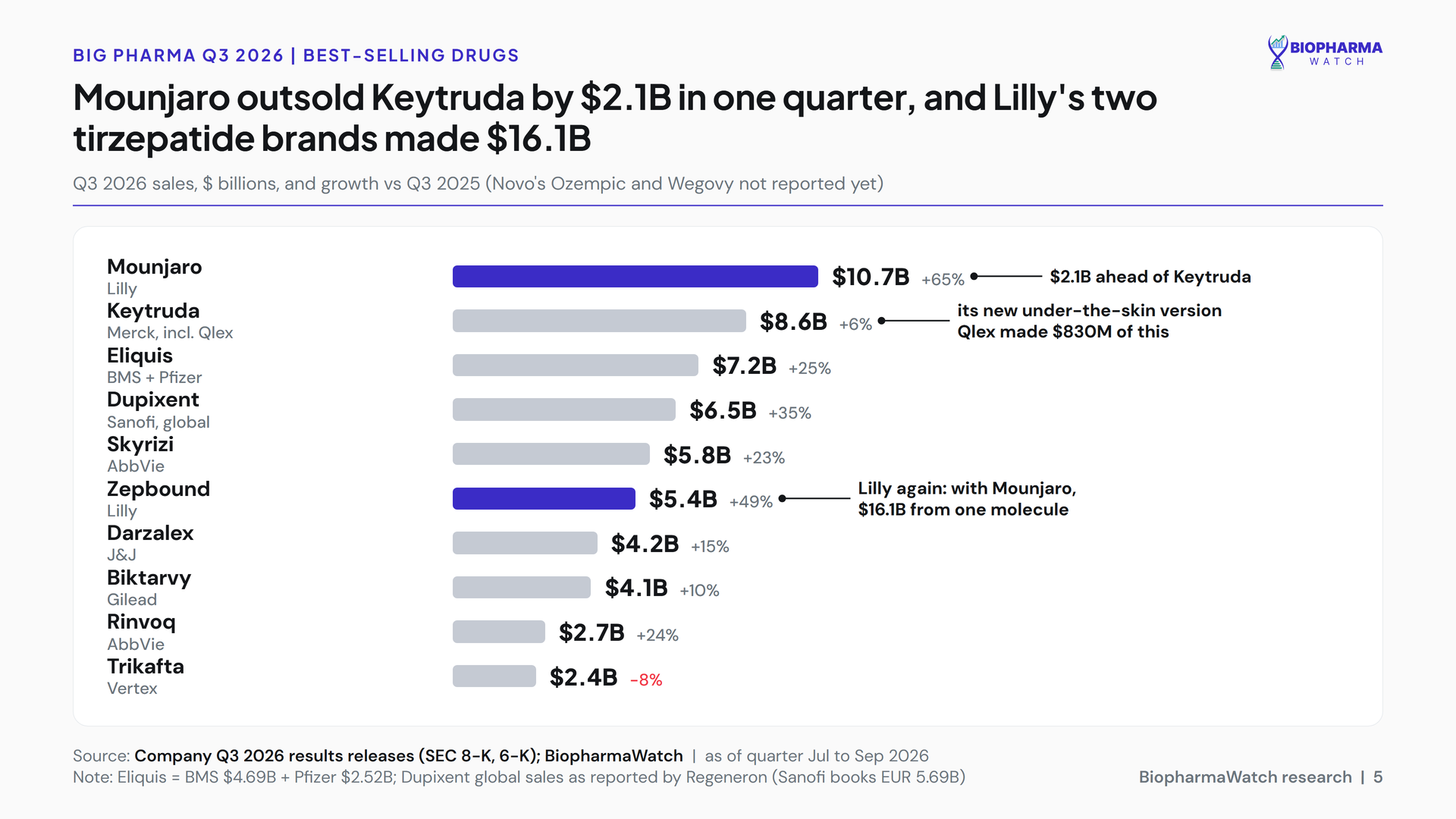
Mounjaro, at $10.7 billion, up 65%. For years the answer was Keytruda, and this is the quarter that changed. Merck's cancer drug made $8.6 billion, up 6%, and that already includes $830 million from Keytruda Qlex, the new version given as an injection under the skin. Mounjaro finished $2.1 billion ahead.
Two notes on how we counted. Eliquis is shared: Bristol Myers Squibb booked $4.69 billion and Pfizer $2.52 billion, and we add the two because the drug is one product. Dupixent is the global figure Regeneron reports; Sanofi books EUR 5.69 billion of it. Just outside the top ten sit Tremfya ($2.4 billion, +68%), Opdivo ($2.4 billion, -6%), Tagrisso ($2.1 billion) and Kisqali ($1.8 billion, +37%). Novo Nordisk's Ozempic and Wegovy are missing only because Novo has not reported yet.
How much do Mounjaro and Zepbound make together?
$16.1 billion in one quarter. Both are tirzepatide: Mounjaro for type 2 diabetes and Zepbound for obesity. Together they are 66% of Lilly's total revenue, and on their own they would rank as the eighth-largest company on this list, ahead of Novartis.
You can see the two brands at the top of Lilly's commercial products table on its LLY company page, which pulls each drug's sales straight from the SEC filings and already shows the September quarter.
Which drugs gained and lost the most sales?
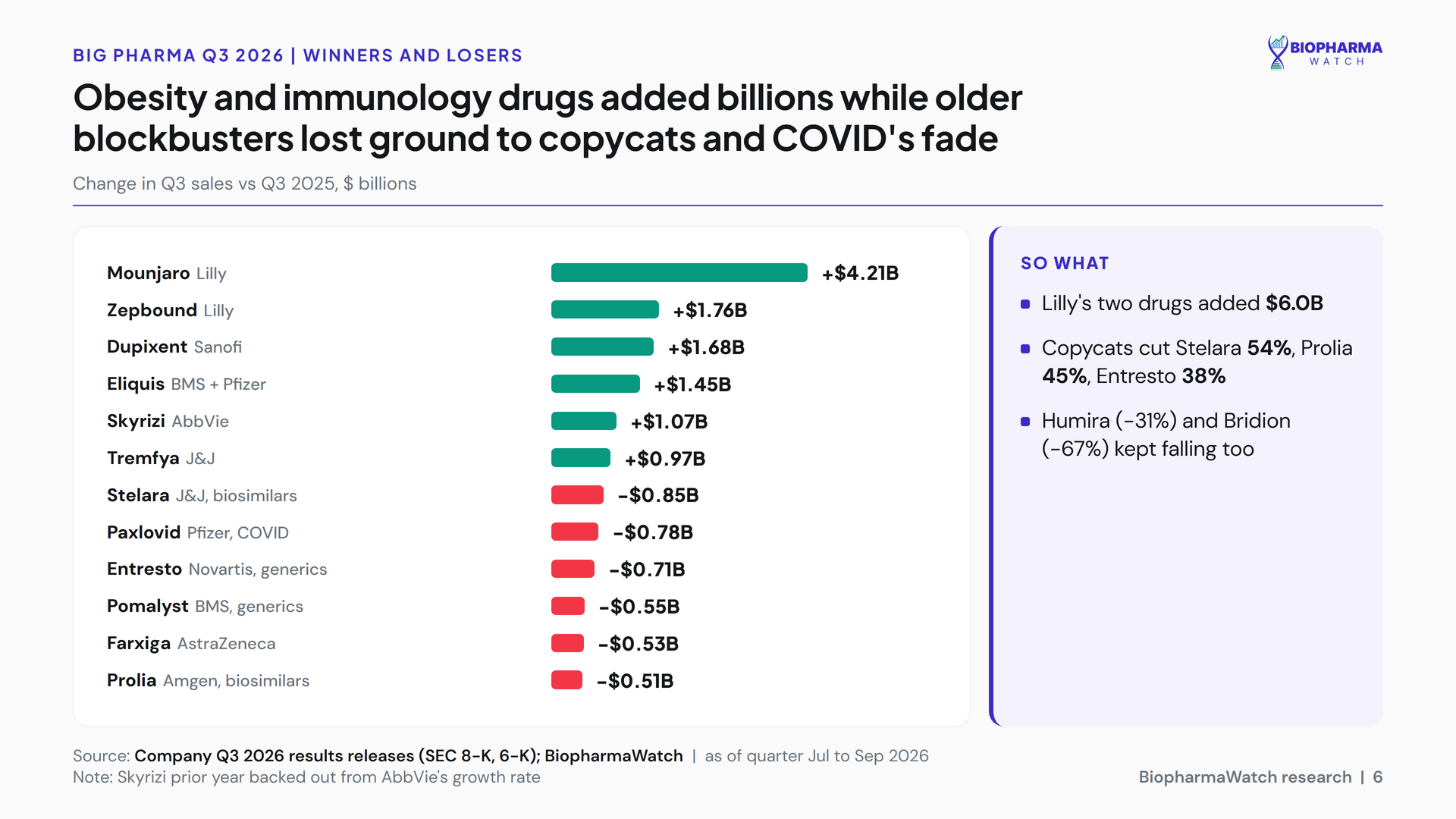
The winners are almost all obesity and immunology drugs. The losers are older blockbusters losing patent protection, plus the last of the COVID products.
Biggest gains (vs Q3 2025)
Change
Biggest losses
Change
Mounjaro (Lilly)
+$4.21B
Stelara (J&J, biosimilars)
-$0.85B
Zepbound (Lilly)
+$1.76B
Paxlovid (Pfizer, COVID)
-$0.78B
Dupixent (Sanofi)
+$1.68B
Entresto (Novartis, generics)
-$0.71B
Eliquis (BMS + Pfizer)
+$1.45B
Pomalyst (BMS, generics)
-$0.55B
Skyrizi (AbbVie)
+$1.07B
Farxiga (AstraZeneca)
-$0.53B
Tremfya (J&J)
+$0.97B
Prolia (Amgen, biosimilars)
-$0.51B
Stelara fell 54% in a year, Prolia 45% and Entresto 38%. That is what a patent cliff looks like in the numbers: not a gentle slope but a drop of a third to a half in the first full year of competition. Humira (-31%) and Merck's Bridion (-67%) kept falling too.
J&J is the clearest example of a company replacing a fading drug. Stelara is collapsing, but Tremfya grew 68% and Darzalex 15%, so J&J still grew almost 6%. Pfizer is the opposite case: its non-COVID products grew 7% operationally, but Paxlovid's $776 million decline was enough to leave the whole company flat, the only one of the 16 that shrank.
Did Big Pharma raise its 2026 guidance?
Yes, broadly. Ten of the 16 raised their revenue or sales outlook for 2026, and none cut it. That is a confident season.
Read the small print on two of them. Takeda's raise is driven by the weak yen, and its release says Albumin and QDENGA underperformed. Merck and J&J only lifted the bottom of their ranges. Novartis kept its sales outlook but raised its profit outlook, and AbbVie, which gives no revenue guidance, raised its adjusted EPS range to $13.95 to $13.99. AstraZeneca, GSK and Biogen kept their outlooks, and Regeneron gives none.
Which Big Pharma companies depend most on one drug?
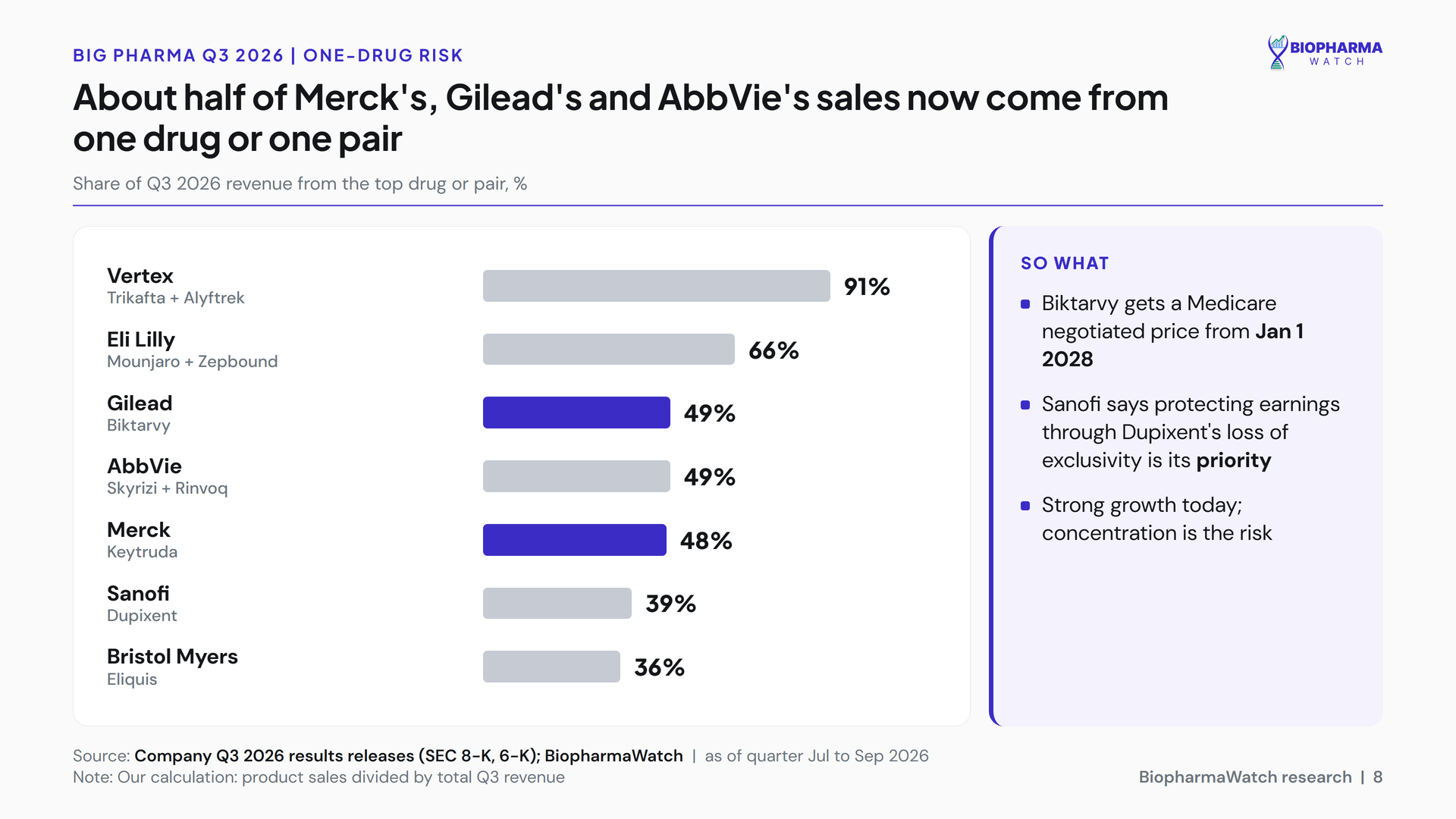
This is the part of earnings season most people skip, and it is where the risk sits. We divided each company's top drug (or top pair) by its total Q3 revenue.
VertexVRTX: 91% from its cystic fibrosis drugs Trikafta and Alyftrek
Eli LillyLLY: 66% from tirzepatide (Mounjaro and Zepbound)
Concentration is fine while the drug is growing, and most of these are. The question is what happens when the protection ends. Gilead's release notes that Biktarvy gets a Medicare negotiated price from January 1, 2028. Sanofi wrote, in plain words, that its priority is to protect earnings through Dupixent's loss of exclusivity. Strong growth today and concentration risk tomorrow are both true for the same companies at the same time.
For the smaller biotechs that live or die on one asset, the same question is sharper, and cash runway decides how long they can wait. Subscribers see cash runway, dilution risk and insider buying for every company we cover; you can start a free trial to see them.
What else stood out in the Q3 results?
J&J took a $5.5 billion pre-tax litigation charge for its proposed ovarian talc resolution, which cut its GAAP EPS to $0.09.
Pfizer booked $742 million of restructuring charges and expects about $1.1 billion of sales lost to generics and biosimilars in 2026.
Novartis wrote off $1.9 billion on del-desiran after the Phase III HARBOR study missed.
AstraZeneca announced up to $2.0 billion of restructuring for $1.5 billion of annual savings and a $2 billion equity stake in Summit Therapeutics.
GSK showed the split inside its business: Specialty medicines +15%, vaccines -2%, with Arexvy down 24% at constant currency.
Amgen has more than 10 Phase 3 studies running for its obesity drug MariTide, with two more starting in Q4 2026.
AbbVie raised its quarterly dividend to $1.82 from $1.73 (+5.2%), starting February 2027.
What are the next catalysts for these companies?
Two dated events came straight out of these releases. VRTX Vertex has an FDA decision due on November 30, 2026 for povetacicept in IgA nephropathy, under priority review. BIIB Biogen expects topline Phase 3 data for litifilimab in lupus in the first half of December 2026. Merck also had its sac-TMT application in endometrial cancer accepted for priority review.
Every figure comes from the company's own third quarter results release filed with the SEC (8-K or 6-K), read in full on November 4, 2026.
Sanofi and GSK are converted to US dollars at the Q3 average of ECB reference rates (EUR 1.1505, GBP 1.3441), used for both years so growth matches each company's reported-currency growth. Takeda is converted at the rate in its own release (157.25 yen per dollar).
Growth percentages are as reported; dollar changes are our arithmetic on the release tables. Skyrizi's prior-year figure is backed out from AbbVie's reported growth rate.
Pfizer's quarter ended September 27 in the US. Takeda's figures are its fiscal Q2 2026.
Novo Nordisk has not reported and is excluded until it does.
Every company in this post has its own page on BiopharmaWatch with its full pipeline, drug-by-drug sales, catalysts and news; search the ticker and scroll to commercial products. The biotech screener covers more than 900 drugmakers. This is education, not investment advice.
Frequently asked questions
Which pharma company had the highest revenue in Q3 2026?›
Johnson & Johnson, with $25.4B, which includes its medical device business. Eli Lilly was second at $24.4B, just $1.0B behind and up 38.6%. Novo Nordisk had not reported yet.
What was the best-selling drug in Q3 2026?›
Mounjaro from Eli Lilly, with $10.7B of sales, up 65%. Keytruda was second at $8.6B, including $830M from the new under-the-skin Keytruda Qlex.
How much did Eli Lilly grow in Q3 2026?›
Revenue rose 38.6% to $24.4B, a gain of $6.8B, which was 35% of the growth of all 16 large drugmakers. Lilly raised its 2026 revenue guidance to $91B to $92B.
Did any Big Pharma company shrink in Q3 2026?›
Only Pfizer, by 0.4%. Its non-COVID products grew 7% operationally, but Paxlovid sales fell by $776M.
How many pharma companies raised guidance after Q3 2026?›
10 of the 16 raised their 2026 revenue or sales outlook and none cut it. Novartis and AbbVie raised profit or EPS guidance only; AstraZeneca, GSK and Biogen kept theirs.
Where does this data come from?›
Each company's third quarter 2026 results release filed with the SEC (8-K or 6-K). Sanofi and GSK are converted at Q3 average ECB rates and Takeda at its own stated rate.