Biotech Hedge Fund 13F Q3 2026: What 43 Funds Bought
BWBiopharmaWatch Research··13 min read
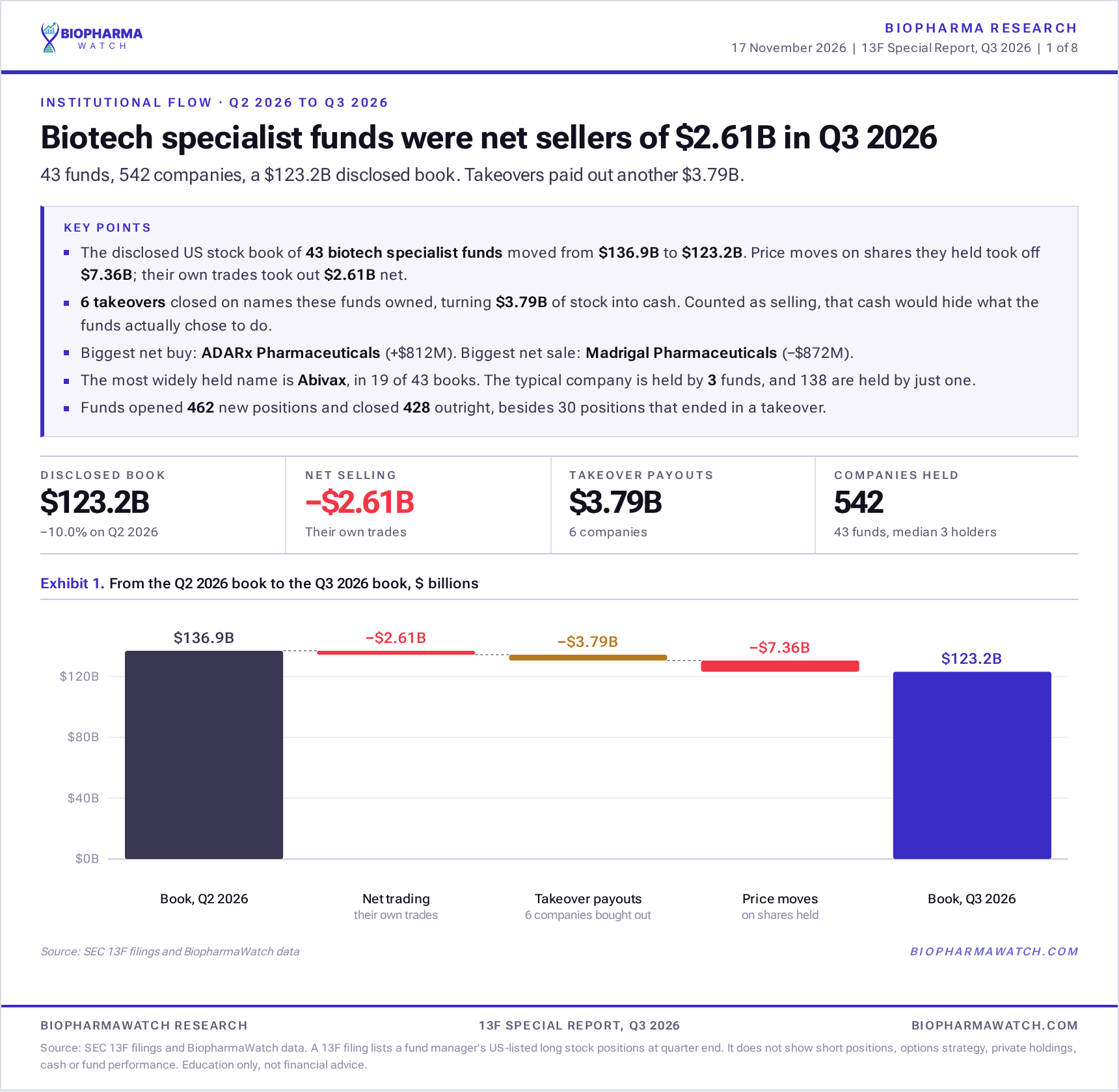
Biotech hedge funds were net sellers of $2.61B of stock in Q3 2026, based on the 13F filings of 43 biotech specialist funds. Their combined disclosed book fell from $136.9B to $123.2B across 542 companies, and 6 takeovers turned another $3.79B of their stock into cash.
This is our quarterly read of where the specialist money went: the stocks funds bought and sold, the disease areas and drug types they favored, the most crowded names, the new positions and full exits, and how they traded the companies that had an FDA decision or a trial result. The full Q3 2026 report is a free PDF: download the 13F special report.
What did biotech hedge funds buy in Q3 2026?
The book fell by $13.8B, or −10.0%. Price moves on shares the funds already held took off $7.36B. Their own trading took out $2.61B net. Takeovers took out another $3.79B of stakes as companies were bought.
That split matters. Counted as selling, takeover payouts would make the funds look like net sellers when the stock left their books because a buyer paid cash for it. With takeovers set aside, 217 companies were net bought and 281 were net sold.
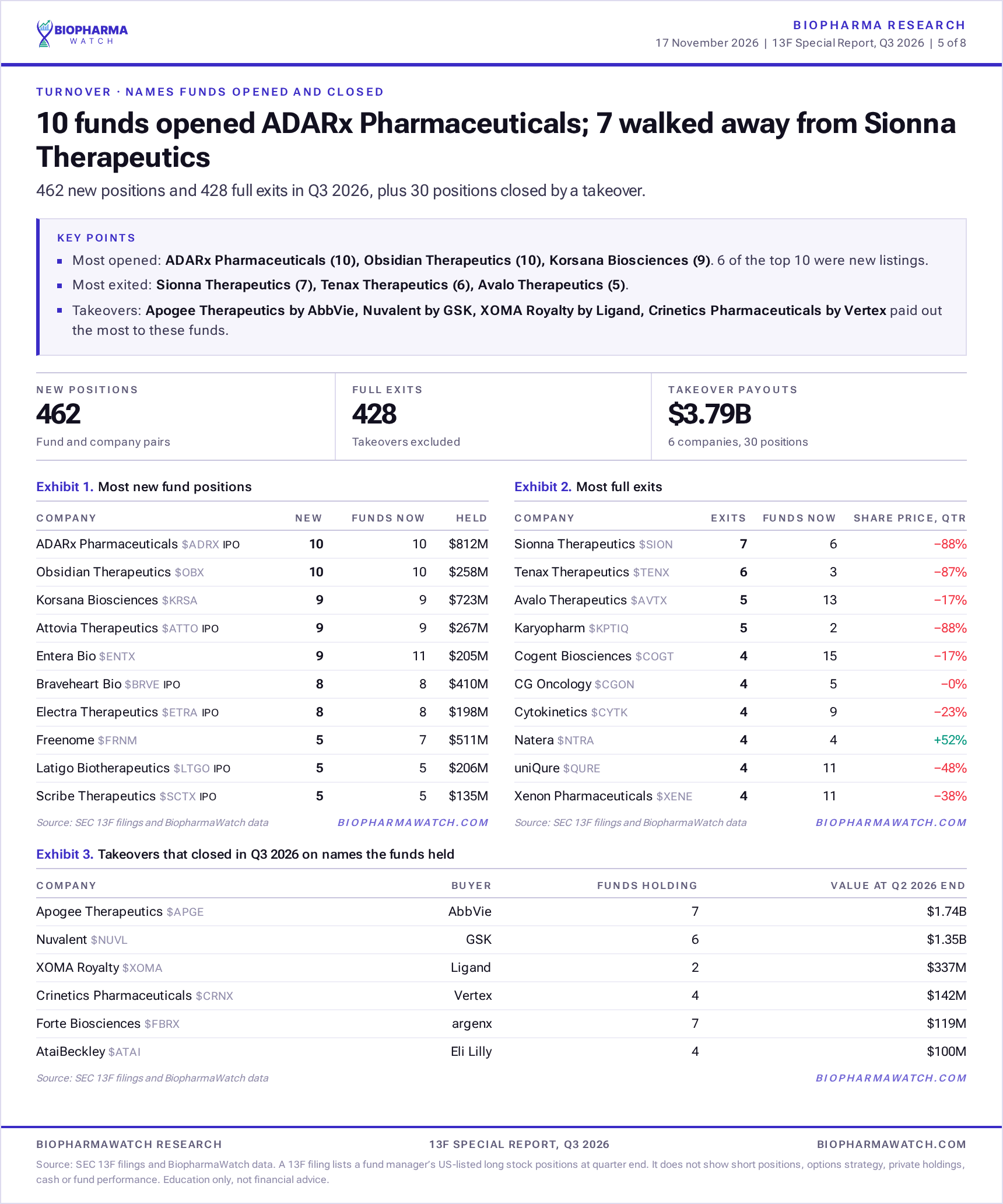
Funds opened 462 new positions and closed 428 outright during the quarter. They added to 452 existing positions and cut 669. The typical company in these books is held by 3 funds, and 138 companies are held by just one.
Which biotech stocks did hedge funds buy the most?
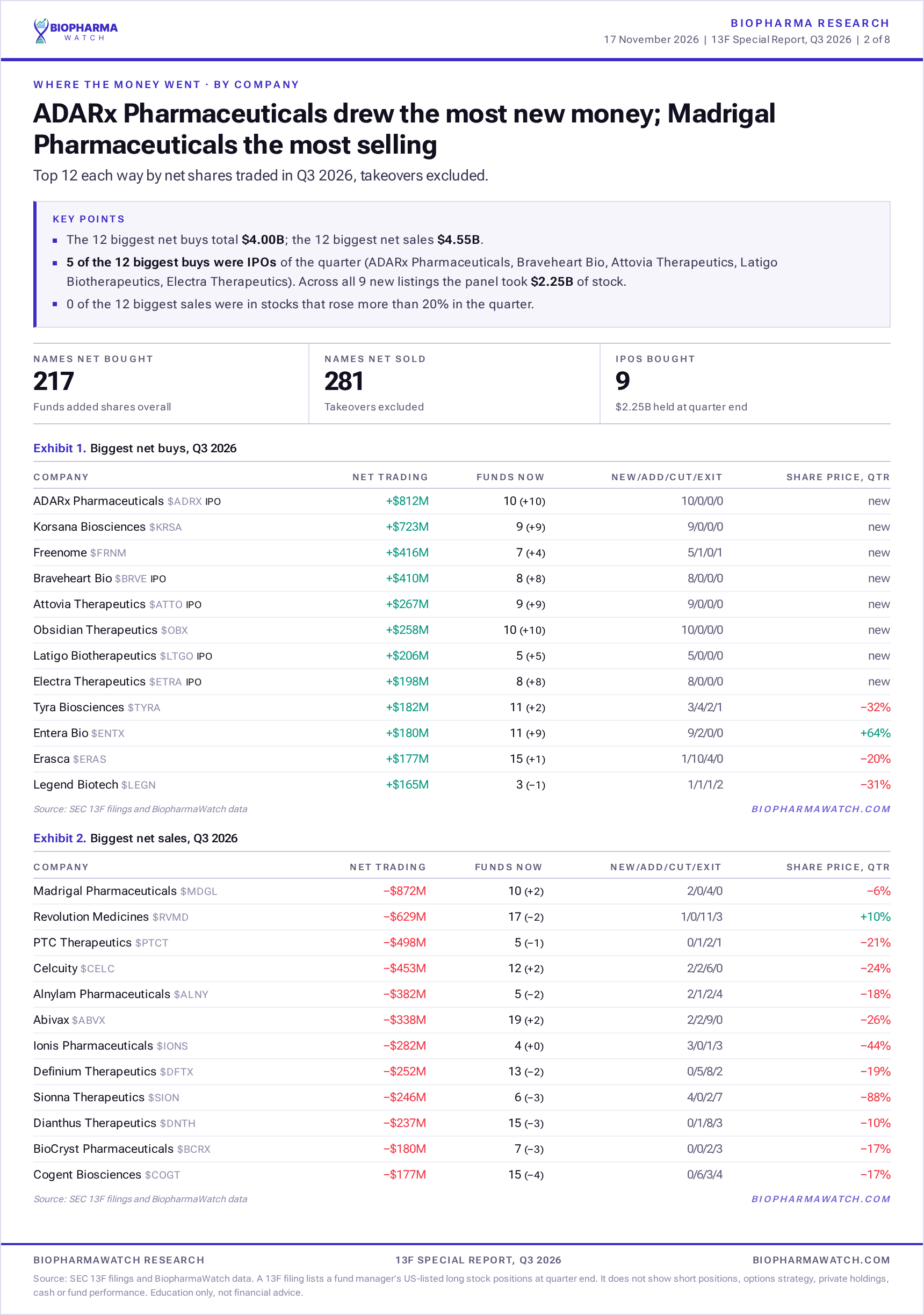
The biggest net buys of Q3 2026 across all 43 funds:
ADARx Pharmaceuticals ($ADRX): +$812M, now held by 10 funds (was 0), listed in the quarter
Entera Bio ($ENTX): +$180M, now held by 11 funds (was 2)
Erasca ($ERAS): +$177M, now held by 15 funds (was 14)
Legend Biotech ($LEGN): +$165M, now held by 3 funds (was 4)
New listings were a large part of the buying. Funds held $2.25B of stock in 9 companies that went public during the quarter, led by ADARx Pharmaceuticals ($ADRX), Braveheart Bio ($BRVE), Attovia Therapeutics ($ATTO).
Which biotech stocks did hedge funds sell?
The biggest net sales, with takeovers left out:
Madrigal Pharmaceuticals ($MDGL): −$872M, held by 10 funds (was 8), share price −6% in the quarter
Revolution Medicines ($RVMD): −$629M, held by 17 funds (was 19), share price +10% in the quarter
PTC Therapeutics ($PTCT): −$498M, held by 5 funds (was 6), share price −21% in the quarter
Celcuity ($CELC): −$453M, held by 12 funds (was 10), share price −24% in the quarter
Alnylam Pharmaceuticals ($ALNY): −$382M, held by 5 funds (was 7), share price −18% in the quarter
Abivax ($ABVX): −$338M, held by 19 funds (was 17), share price −26% in the quarter
Ionis Pharmaceuticals ($IONS): −$282M, held by 4 funds (was 4), share price −44% in the quarter
Definium Therapeutics ($DFTX): −$252M, held by 13 funds (was 15), share price −19% in the quarter
Sionna Therapeutics ($SION): −$246M, held by 6 funds (was 9), share price −88% in the quarter
Dianthus Therapeutics ($DNTH): −$237M, held by 15 funds (was 18), share price −10% in the quarter
BioCryst Pharmaceuticals ($BCRX): −$180M, held by 7 funds (was 10), share price −17% in the quarter
Cogent Biosciences ($COGT): −$177M, held by 15 funds (was 19), share price −17% in the quarter
0 of the 12 biggest sales were in stocks that rose more than 20% in the quarter.
Which disease areas drew the most hedge fund money?
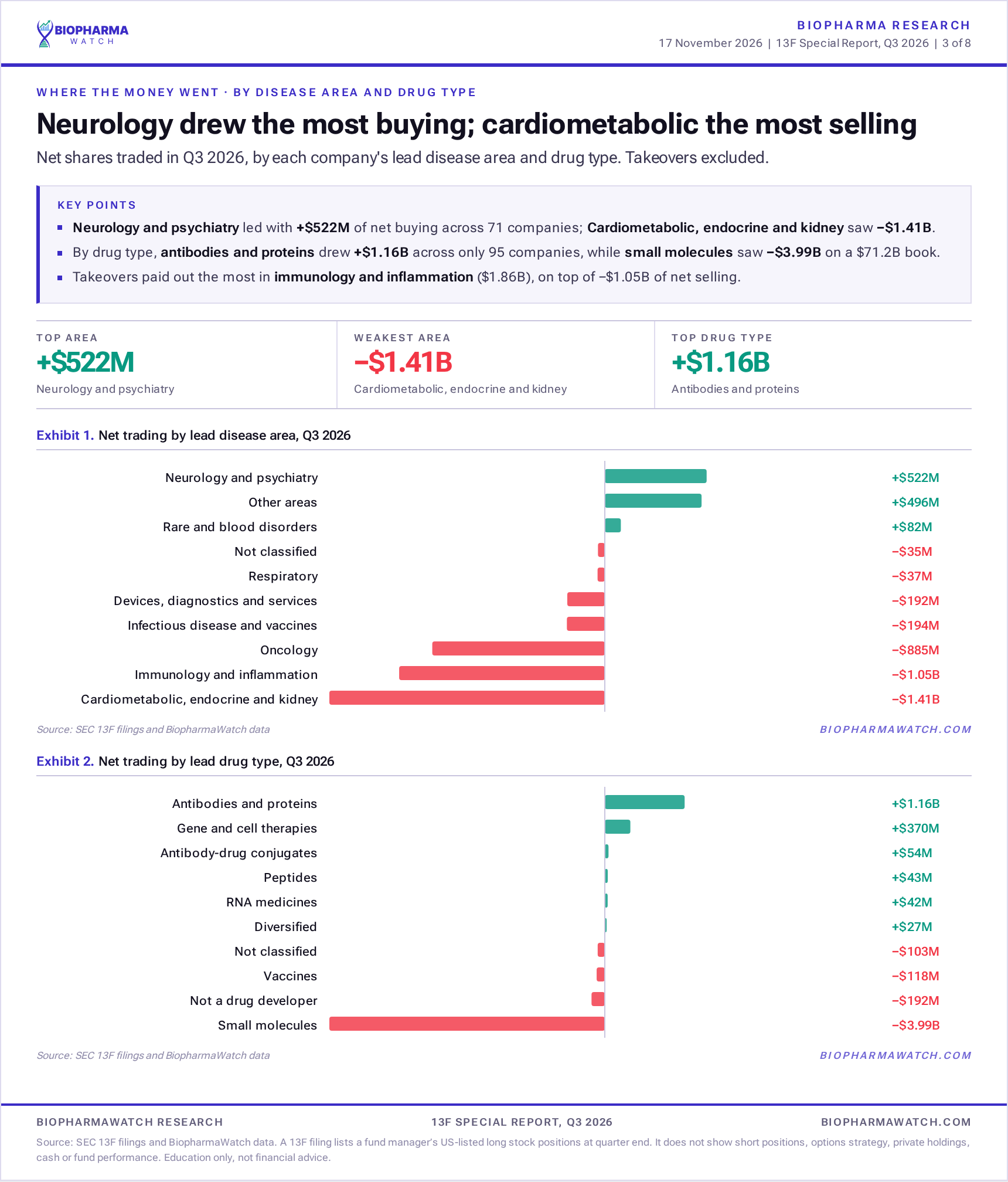
Net trading by each company's lead disease area, takeovers excluded:
Neurology and psychiatry: +$522M across 71 companies, plus $100M paid out in takeovers
Other areas: +$496M across 83 companies, plus $337M paid out in takeovers
Rare and blood disorders: +$82M across 35 companies
Not classified: −$35M across 33 companies
Respiratory: −$37M across 12 companies
Devices, diagnostics and services: −$192M across 20 companies
Infectious disease and vaccines: −$194M across 29 companies
Oncology: −$885M across 147 companies, plus $1.35B paid out in takeovers
Immunology and inflammation: −$1.05B across 46 companies, plus $1.86B paid out in takeovers
Cardiometabolic, endocrine and kidney: −$1.41B across 103 companies, plus $142M paid out in takeovers
Which drug types did funds favor?
By the type of medicine a company mainly develops:
Antibodies and proteins: +$1.16B across 95 companies, $22.9B held at quarter end
Gene and cell therapies: +$370M across 33 companies, $6.18B held at quarter end
Antibody-drug conjugates: +$54M across 3 companies, $676M held at quarter end
Peptides: +$43M across 10 companies, $10.3B held at quarter end
RNA medicines: +$42M across 6 companies, $2.74B held at quarter end
Diversified: +$27M across 2 companies, $209M held at quarter end
Other: +$2M across 2 companies, $173M held at quarter end
Not classified: −$103M across 68 companies, $2.72B held at quarter end
Vaccines: −$118M across 4 companies, $1.38B held at quarter end
Not a drug developer: −$192M across 20 companies, $3.89B held at quarter end
Small molecules: −$3.99B across 336 companies, $71.2B held at quarter end
Antibodies and proteins drew +$1.16B across only 95 companies, the most money per company of any type. Small molecules saw −$3.99B, though they still make up 58% of the money held in companies.
What are the most crowded biotech stocks among hedge funds?
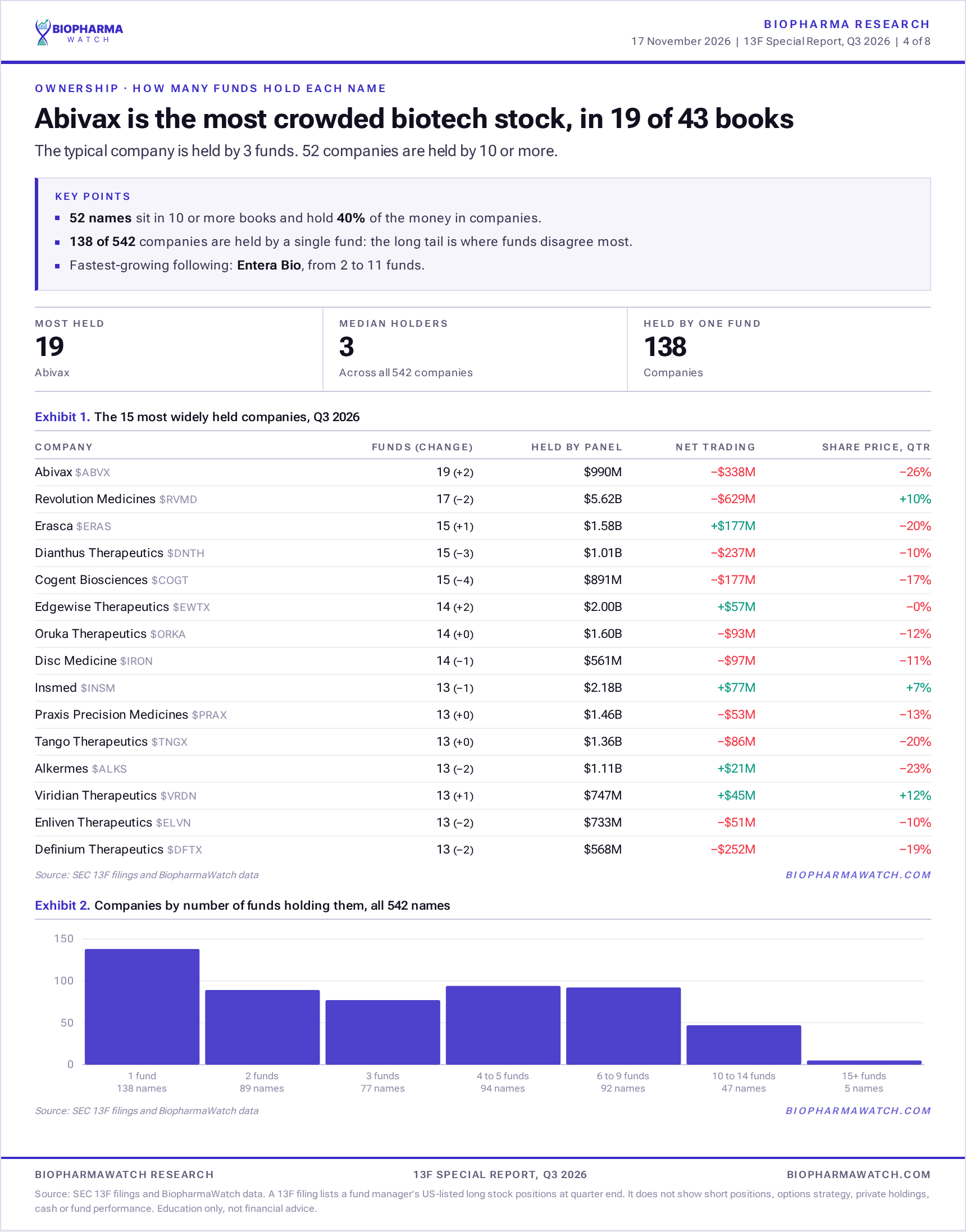
The companies held by the most funds at the end of Q3 2026:
Abivax ($ABVX): 19 funds (+2), $990M held, net sold $338M
52 companies sit in 10 or more books and hold 40% of the money in companies. Crowded names can move hard when several holders sell at once, so the count of holders is worth watching next to the price.
Which new positions did funds open, and which did they exit?
6 companies held by these funds were bought during the quarter. The largest payouts to the panel:
Apogee Therapeutics ($APGE), bought by AbbVie: held by 7 funds, worth $1.74B at the end of Q2 2026
Nuvalent ($NUVL), bought by GSK: held by 6 funds, worth $1.35B at the end of Q2 2026
XOMA Royalty ($XOMA), bought by Ligand: held by 2 funds, worth $337M at the end of Q2 2026
Crinetics Pharmaceuticals ($CRNX), bought by Vertex: held by 4 funds, worth $142M at the end of Q2 2026
Forte Biosciences ($FBRX), bought by argenx: held by 7 funds, worth $119M at the end of Q2 2026
AtaiBeckley ($ATAI), bought by Eli Lilly: held by 4 funds, worth $100M at the end of Q2 2026
How did funds trade stocks with FDA decisions or trial results?
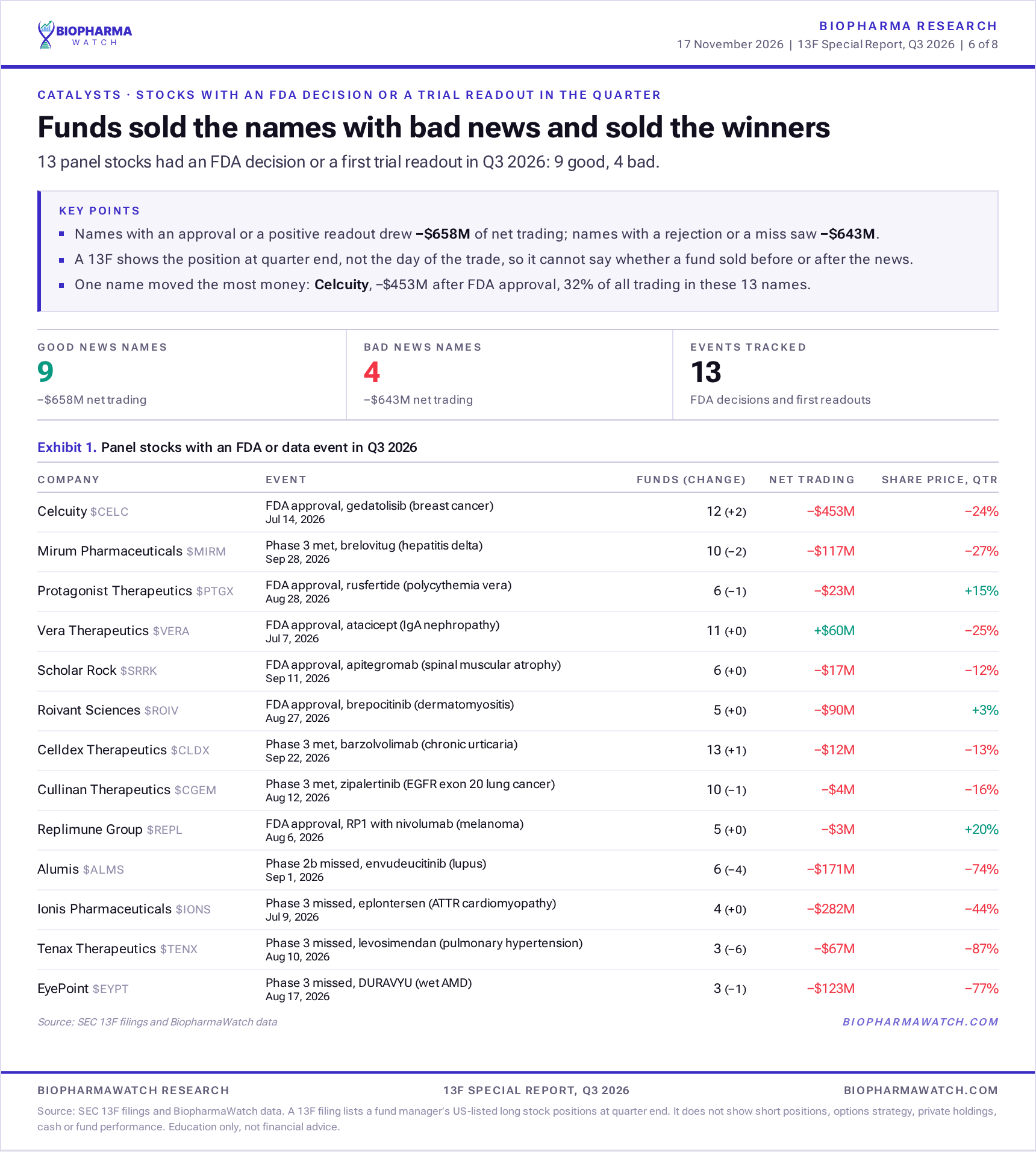
13 stocks in these books had an FDA decision or a first trial readout in Q3 2026: 9 with good news and 4 with bad. Names with an approval or a positive readout drew −$658M of net trading; names with a rejection or a missed trial saw −$643M.
Celcuity ($CELC): FDA approval, gedatolisib (breast cancer) on Jul 14, 2026. Funds net sold $453M; holders went from 10 to 12
Mirum Pharmaceuticals ($MIRM): Phase 3 met, brelovitug (hepatitis delta) on Sep 28, 2026. Funds net sold $117M; holders went from 12 to 10
Protagonist Therapeutics ($PTGX): FDA approval, rusfertide (polycythemia vera) on Aug 28, 2026. Funds net sold $23M; holders went from 7 to 6
Vera Therapeutics ($VERA): FDA approval, atacicept (IgA nephropathy) on Jul 7, 2026. Funds net bought $60M; holders went from 11 to 11
Scholar Rock ($SRRK): FDA approval, apitegromab (spinal muscular atrophy) on Sep 11, 2026. Funds net sold $17M; holders went from 6 to 6
Roivant Sciences ($ROIV): FDA approval, brepocitinib (dermatomyositis) on Aug 27, 2026. Funds net sold $90M; holders went from 5 to 5
Celldex Therapeutics ($CLDX): Phase 3 met, barzolvolimab (chronic urticaria) on Sep 22, 2026. Funds net sold $12M; holders went from 12 to 13
Cullinan Therapeutics ($CGEM): Phase 3 met, zipalertinib (EGFR exon 20 lung cancer) on Aug 12, 2026. Funds net sold $4M; holders went from 11 to 10
Replimune Group ($REPL): FDA approval, RP1 with nivolumab (melanoma) on Aug 6, 2026. Funds net sold $3M; holders went from 5 to 5
Alumis ($ALMS): Phase 2b missed, envudeucitinib (lupus) on Sep 1, 2026. Funds net sold $171M; holders went from 10 to 6
Ionis Pharmaceuticals ($IONS): Phase 3 missed, eplontersen (ATTR cardiomyopathy) on Jul 9, 2026. Funds net sold $282M; holders went from 4 to 4
Tenax Therapeutics ($TENX): Phase 3 missed, levosimendan (pulmonary hypertension) on Aug 10, 2026. Funds net sold $67M; holders went from 9 to 3
EyePoint ($EYPT): Phase 3 missed, DURAVYU (wet AMD) on Aug 17, 2026. Funds net sold $123M; holders went from 4 to 3
A 13F shows each position at quarter end, not the day of a trade, so it cannot tell whether a fund sold before or after the news. It shows where the fund ended up.
What are the largest biotech hedge fund books?
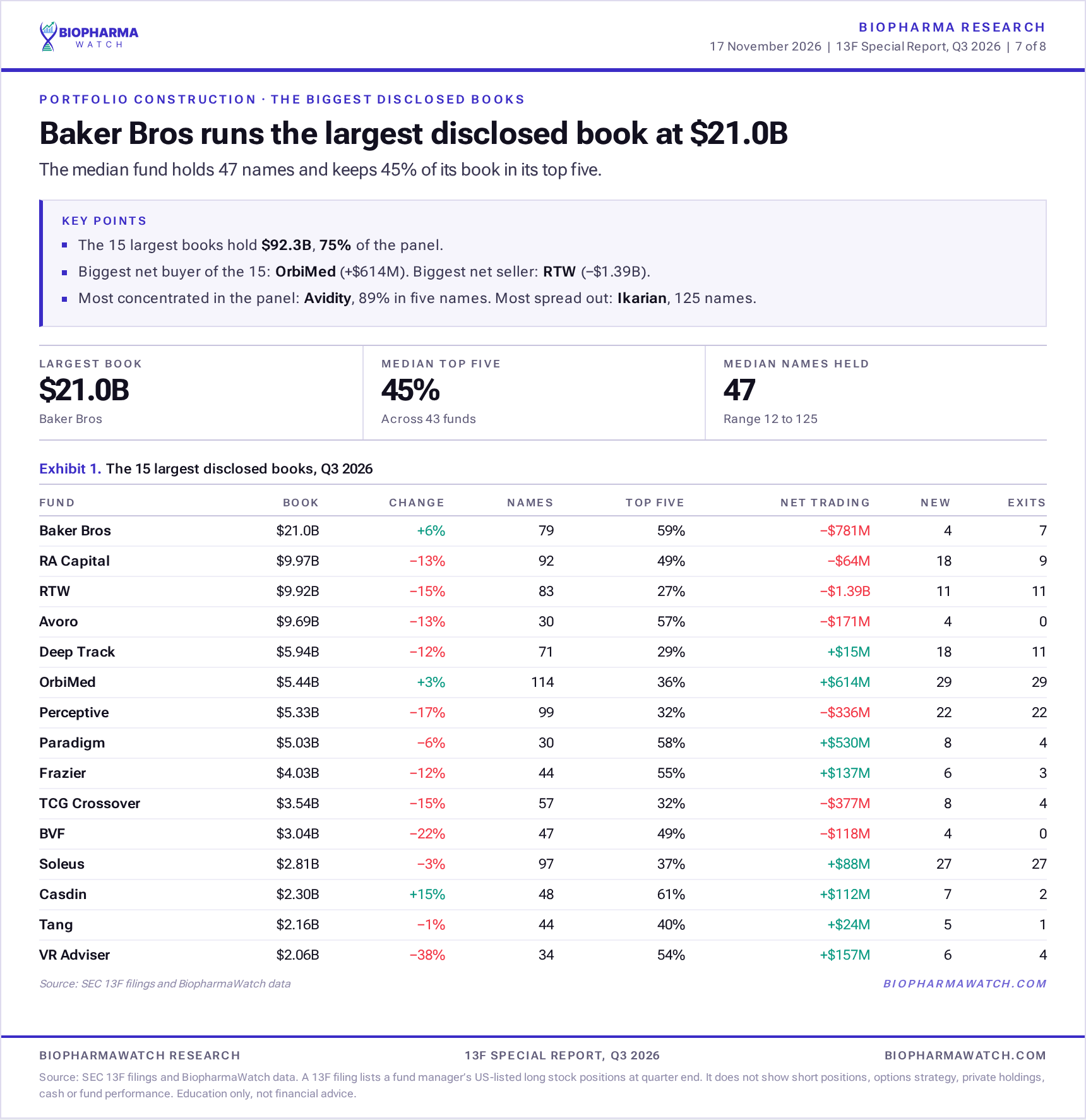
The 15 largest disclosed books hold $92.3B, 75% of the panel. The median fund holds 47 companies and keeps 45% of its book in its five largest positions. One line on each:
Baker Bros: $21.0B across 79 names, 59% in the top five, largest position Incyte ($INCY) at 18%. Net sold $781M; biggest new buy First Tracks Biotherapeutics ($TRAX) ($17M); biggest exit Alumis ($ALMS).
Avoro: $9.69B across 30 names, 57% in the top five, largest position United Therapeutics ($UTHR) at 15%. Net sold $171M; biggest new buy Abivax ($ABVX) ($48M).
Deep Track: $5.94B across 71 names, 29% in the top five, largest position Guardant Health ($GH) at 8%. Net bought $15M; biggest new buy Insmed ($INSM) ($154M); biggest exit Alnylam Pharmaceuticals ($ALNY).
Frazier: $4.03B across 44 names, 55% in the top five, largest position Mirum Pharmaceuticals ($MIRM) at 16%. Net bought $137M; biggest new buy Attovia Therapeutics ($ATTO) ($121M); biggest exit BridgeBio Pharma ($BBIO).
TCG Crossover: $3.54B across 57 names, 32% in the top five, largest position Abivax ($ABVX) at 10%. Net sold $377M; biggest new buy Korsana Biosciences ($KRSA) ($146M); biggest exit Revolution Medicines ($RVMD).
BVF: $3.04B across 47 names, 49% in the top five, largest position Revolution Medicines ($RVMD) at 17%. Net sold $118M; biggest new buy Pyxis Oncology ($PYXS) ($28M).
Soleus: $2.81B across 97 names, 37% in the top five, largest position Krystal Biotech ($KRYS) at 13%. Net bought $88M; biggest new buy Zai Lab ($ZLAB) ($41M); biggest exit Globus Medical ($GMED).
Tang: $2.16B across 44 names, 40% in the top five, largest position Aurinia Pharmaceuticals ($AUPH) at 10%. Net bought $24M; biggest new buy Ardelyx ($ARDX) ($31M); biggest exit Capricor Therapeutics ($CAPR).
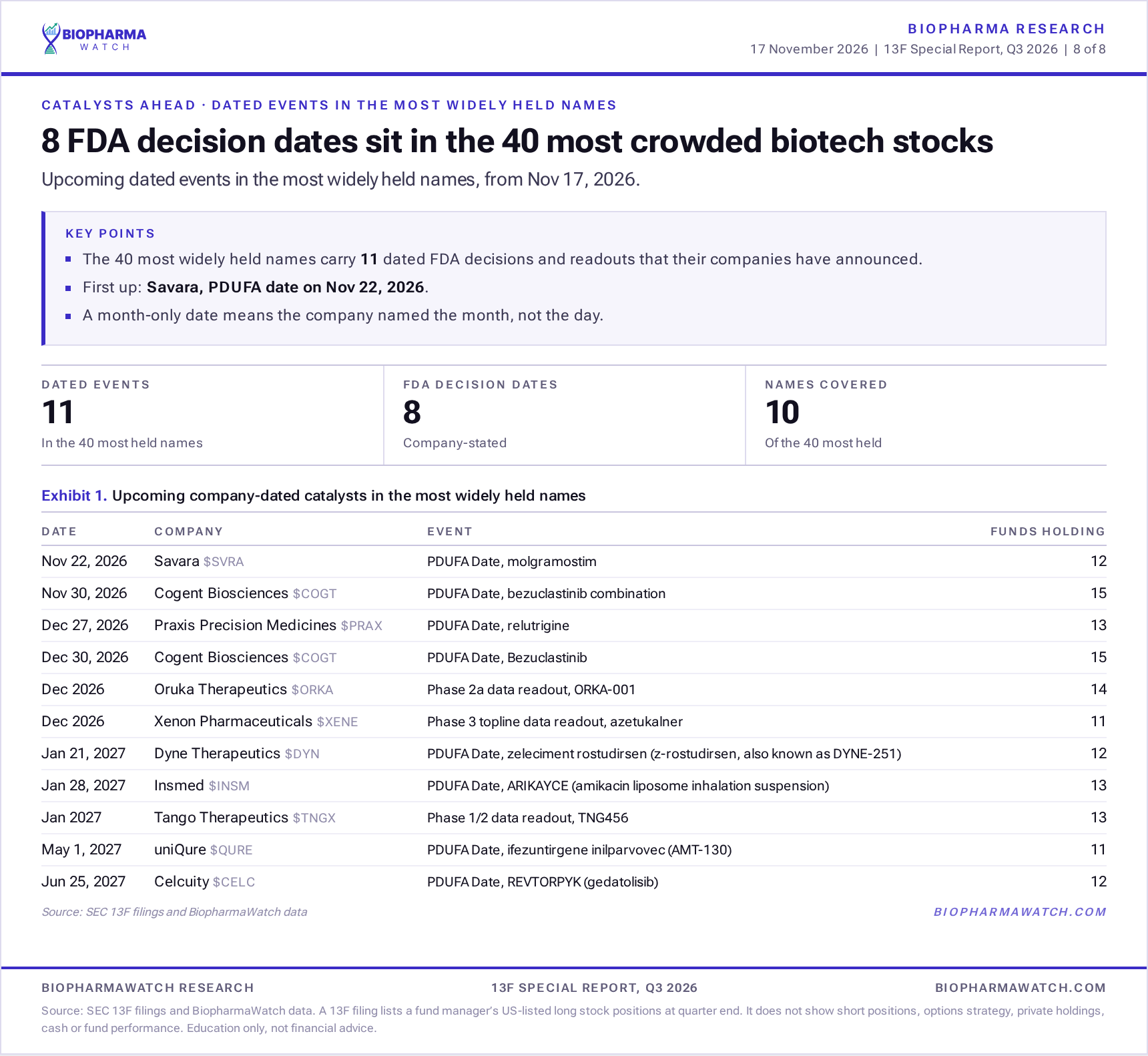
Dec 2026: Oruka Therapeutics ($ORKA), phase 2a data readout for ORKA-001 (14 funds hold it)
Dec 2026: Xenon Pharmaceuticals ($XENE), phase 3 topline data readout for azetukalner (11 funds hold it)
Jan 21, 2027: Dyne Therapeutics ($DYN), PDUFA date for zeleciment rostudirsen (z-rostudirsen, also known as DYNE-251) (12 funds hold it)
Jan 28, 2027: Insmed ($INSM), PDUFA date for ARIKAYCE (amikacin liposome inhalation suspension) (13 funds hold it)
Jan 2027: Tango Therapeutics ($TNGX), phase 1/2 data readout for TNG456 (13 funds hold it)
May 1, 2027: uniQure ($QURE), PDUFA date for ifezuntirgene inilparvovec (AMT-130) (11 funds hold it)
Jun 25, 2027: Celcuity ($CELC), PDUFA date for REVTORPYK (gedatolisib) (12 funds hold it)
What does a 13F filing show, and what does it miss?
A 13F lists a fund manager's US-listed long stock positions at the end of each quarter, filed up to 45 days later. It does not show short positions, private holdings, cash or how the fund performed. A fund can hold a stock for a reason a filing cannot show, such as a hedge elsewhere in its book. Read these moves as where the money sat, not as advice.
Every company above has a page with its fund holders by quarter, insider trades, pipeline, cash runway and upcoming catalysts. Members get the full holder lists, PoA and alerts: see plans.
Frequently asked questions
Were biotech hedge funds buying or selling in Q3 2026?›
Selling. The 43 funds net sold $2.61B of stock, leaving out $3.79B paid to them in takeovers.
What was the most bought biotech stock by hedge funds in Q3 2026?›
ADARx Pharmaceuticals, with +$812M of net buying; 10 funds held it at quarter end.
What is the most crowded biotech stock among hedge funds?›
Abivax, held by 19 of the 43 biotech specialist funds at the end of Q3 2026.
Which biotech hedge fund has the largest book?›
Baker Bros, with a $21.0B disclosed US stock book across 79 companies.
Does a 13F show hedge fund performance?›
No. A 13F lists US-listed long stock positions at quarter end. It leaves out short positions, private holdings and cash, so it says nothing about how a fund performed.